


As the nation approaches its 250th anniversary, a paradox sits at the center of American public life: voters revere the founding documents more than almost anything else in politics, and simultaneously believe the country is abandoning them.
The survey data is striking in its clarity. More than four-in-five registered voters affirm that the core principles of the Declaration of Independence equality, the right to life, liberty, and the pursuit of happiness remain relevant today. This is not a narrow majority or a partisan lean. It is a consensus figure that holds across demographic lines — the kind of number that rarely appears in modern polling on any subject. Americans are not ambivalent about their founding ideals. They claim them emphatically.
And yet nearly two-in-three of those same voters believe the country is moving further away from those principles, not closer. Only a small fraction roughly one-in-six see the nation trending in the right direction on this question. The gap between reverence and reality is enormous, and it carries a specific emotional charge heading into the celebration of America at 250: Americans feel they are losing something they still deeply value.
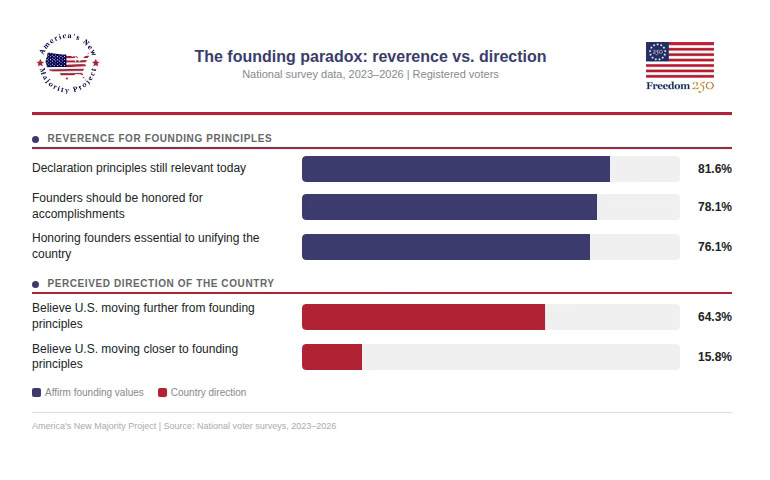
This tension extends to how voters regard the founders themselves. A commanding majority believe the founding fathers should be honored for their accomplishments even while acknowledging they were wrong about slavery. A similarly large share go further, agreeing that honoring the founders is essential to unifying a diverse country. These are not culture-war responses. They reflect a practical judgment: that the founding generation built something worth preserving and that the framework they left behind — particularly the Constitution — remains the most credible common ground available in a fractured nation.
That framework, however, is under pressure from competing visions of what rights mean and who they protect. The First Amendment remains a touchstone, but the polling reveals real fault lines beneath the surface. When asked whether preventing discrimination should take precedence over preserving speech and religious liberty, voters tilt toward protecting the First Amendment but not overwhelmingly. The margin is single digits, suggesting a public that takes both values seriously and resists being forced to choose.
On specific applications, the pattern holds. Strong majorities oppose government censorship of religious texts, even when framed as a measure to prevent discrimination. Voters draw careful lines around protest rights most believe political dissent should be protected, but support for speech protections drops sharply when expression crosses into endorsing violence. These are not contradictions. They are the boundaries of a public that wants robust liberty with enforceable limits and expects its institutions to manage that balance rather than collapse it.
The question for July 4, 2026, is whether political leaders will meet the electorate where it stands. The data describes a public that wants to celebrate the founding, believes the constitutional framework still works, and is frustrated that the country’s direction does not match its stated values. This is not cynicism. It is an invitation — one that arrives with a deadline, a national birthday, and a population that still believes the original promise is worth keeping. Whether anyone in power takes this seriously is the open question the data cannot answer.