


Most Americans say they oppose Operation Epic Fury, however, surveys by America’s New Majority Project, collected in 2024 and 2025, showed support for military action against Iran. That support was strong, it held up even when people were told it could lead to a bigger conflict, and the data suggests it can be recovered.
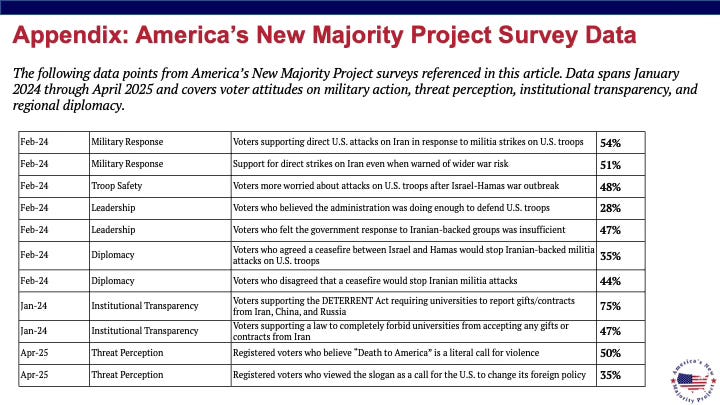
In February 2024, when armed groups funded by Iran were attacking American troops in the Middle East, nearly 54% of voters said the United States should strike Iran directly. When the survey warned that strikes could lead to a wider war, support barely dropped — still above 51%. Almost half of voters said they were more worried than before about the safety of troops overseas. Only about 28% thought the government was doing enough to protect them, while close to 47% said the response was not strong enough. Americans were ready for action and frustrated that it had not happened.
That frustration ran deep. Only 35% of voters believed a peace deal between Israel and Hamas would stop Iranian-backed groups from attacking American forces. In April 2025, just over half of registered voters said they believe “Death to America” is a genuine call for violence, not just political talk.
The lesson for today is that when military action is tied to protecting troops and stopping Iranian aggression, most voters support striking Iran. A Reuters and Ipsos poll conducted right after the strikes backs this up — nearly half said they would support the war if it ended Iran’s nuclear program or led to a friendlier government in Tehran. As Republican pollster Bill McInturff put it: “Attitudes shift in this country based on results.” The support is not gone. It is waiting.
The bottom line, before the war, most Americans believed Iran was a serious threat, diplomacy had failed, and force was justified. The path to building support for Operation Epic Fury is clear: explain the goal in terms of U.S. interests and show results. A March 2026 McLaughlin & Associates national survey of 1,000 likely voters reinforces this point: 51% approved of military action to eliminate Iran’s nuclear program, rising to 57% when voters were reminded of Iran’s decades of hostility, and 59% agreed the U.S. should finish the job rather than face the same threat again later.

It is not rocket science. Islamic objective is world wide hegemony. To that end they have shown radical dedication in their past actions. The world suffers very much from their violent activities everywhere. Now that they have managed to invade Europe in a significant way we can see the damage and danger they have subjected peaceful and innocent people in their home countries.
It will never stop no matter what diplomacy is applied. The only thing they understand is raw power. Iran has been threatening and carrying out their threats for almost half a century. America was correct in siding with Israel to stop the never ending violence. The last seven presidents all agreed that Iran should be stopped but none of them had the courage of their convictions until the much disliked Trump came into the picture. Only he has the bravura to do the right thing. Everyone else is all talk and no action. All talk but no walk.