

Yogi Berra, the famous Yankees catcher, said you can observe a lot just by watching. Over two weeks we watched six men on April 1, eight women on April 2, and a national open-ended survey of nearly 900 voters.
We pulled together several pieces of research and looked for what they had in common. The first was a national survey of around 900 Americans, designed to map the lay of the land — what voters care about, who they trust, and what they’re feeling.
The second was a focus group with men and women from across the country. All told a similar story.
THE MEN — 6 PARTICIPANTS
Party: 4 Independent, 1 Republican, 1 non-voter
2024 Vote: 4 voted Trump, 1 other candidate, 1 did not vote
Income: Median $40K–$79K
Ethnicity: 2 White, 2 African American, 1 Mixed Race, 1 Middle Eastern
States: KY, AZ, MA, IL, WV
THE WOMEN — 8 PARTICIPANTS
Party: 6 Republican, 1 Independent, 1 non-voter
2024 Vote: 7 voted Trump, 1 did not vote
Income: Median $60K–$79K
Ethnicity: 5 White, 2 African American, 1 mixed
States: MI, LA, MT, TN, PA, FL
Three studies, one message, one surprise.
What everyone agrees on
Cost of living is the only issue. Half the focus-group participants named finances first, unprompted.
Nobody trusts politicians. Every man in the room said no politician could convince him the economy is improving. About 1 in 4 voters nationally say the same.
Government takes the blame. Six of eight women blamed government for rising prices. Men blamed government and corporations together — “the same gang, different colors.”
Proof beats promises. Nearly half of national respondents said only visibly falling prices would convince them a leader means it.
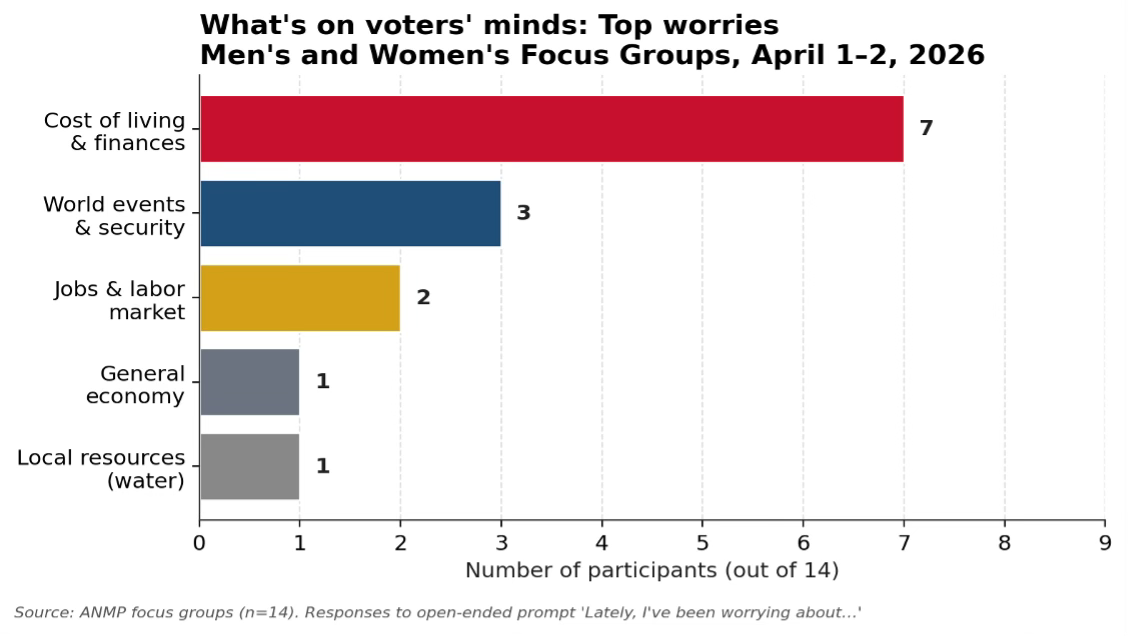
When asked “Lately, I’ve been worrying about…,” half the room named finances before anything else.
The surprise: men and women want different proof
We tested two statements a candidate might use:
Statement A: “We passed legislation that will lower costs.”
Statement B: “The average grocery bill dropped by $40 a month.”
Men: 6–0 for Statement A. They want a paper trail. “Legislation is either you passed it or you didn’t,” one Arizona Independent told us.
Women: 5–3 for Statement B. They want a number they can feel at the register. Nicole in Pennsylvania, a mother of three “scraping change” most weeks, said the dollar figure “seems like things were compared.”
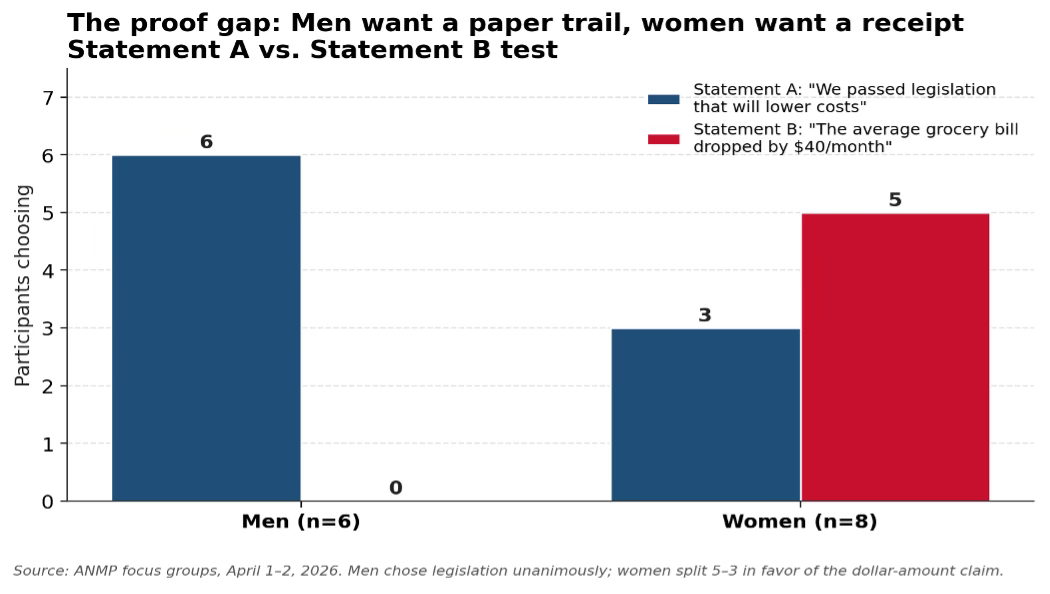
Same skepticism, different standards of proof.
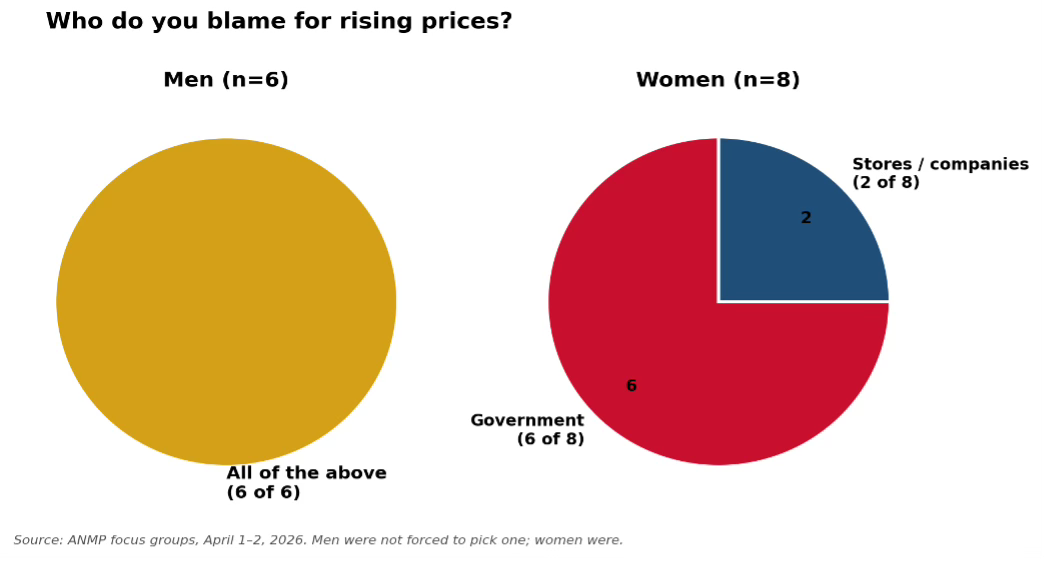
Men won't pick between government and corporations. Women will — and government takes the hit 3 to 1.
“I trust them to be who they are, and that is dishonest.”
- Participant Men’s Focus Group April 1, 2026
What we still don't know
Just fourteen voters in two rooms can’t tell us the full story of how the country will vote in November. But here’s a quick update on what a recent national survey is showing.
Is the men-vs-women proof gap real at scale? If yes, every economic message needs two versions.
Which specific policy do voters want? Tariffs, energy, price caps, or tax cuts — forced-choice, segmented.
How wide is the awareness gap? Both groups reacted to OBBBA provisions (no tax on tips, blocking the $1,700 hike, senior deductions). Almost nobody knew they existed.
What’s driving rural healthcare concern? It runs triple the national average — hospital closures, insurance, or prescriptions?
Where is the education vulnerability? The one issue where women leaned Democratic. How deep does that go?
THE BOTTOM LINE
Americans know what they want: proof, not promises. But they don’t agree on what “proof” looks like. That divide is the single biggest finding across all three studies and it’s also the one we’re least certain about. Campaigns are about to spend millions building messages on assumptions that currently rest on just fourteen voters.
These small focus groups are a sign of smoke, not a fire. They point us toward the right questions, but they can’t tell us whether Americans are actually persuadable or whether they’ve already made up their minds and nothing a candidate says will matter. What Americans are really looking for, and whether any message can still reach them, is exactly what a full national survey can show.
With the 2026 midterms close, guessing is not a strategy. The next step is a full national survey 30 to 40 questions, with split-sample tests on the exact message formats we heard in these rooms.
Sources: Occam National Survey (March 2026, n≈900); ANMP Men’s Focus Group (April 1, 2026, n=6); ANMP Women’s Focus Group (April 2, 2026, n=8).
Charts prepared using AI and using ANMP data and edited by humans.