


Key Takeaways
Fact-anchored contrast messages outperform attack messages on five tested issues—a consistent net differential of 5 to 9 points overall, and up to 14 points among Independents.
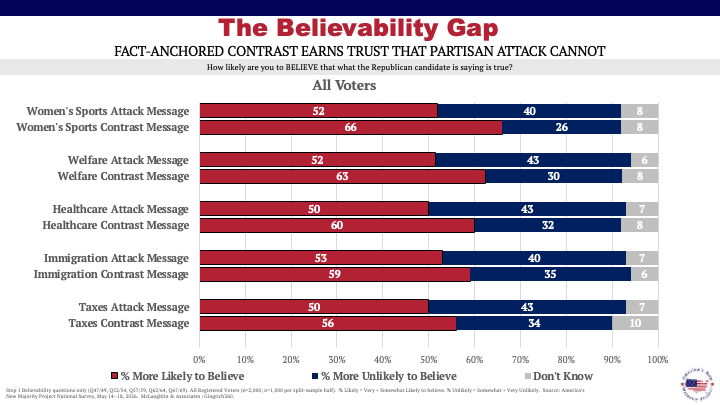
Believability is higher for contrast messages on every issue—gaps range from 6 to 14 points. The attack message never exceeds 52% believability and never matches the floor of any contrast message tested.
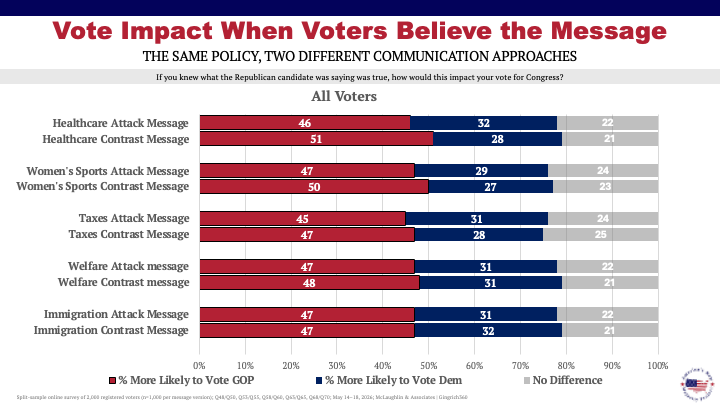
Contrast messages produce stronger movement among Independents on four of five issues—most pronounced on healthcare (+26 vs. +12) and taxes (+23 vs. +12). Independents are the demographic most sensitive to message structure.
Two structural elements drive the gap: a verification offer and a positive statement of what the candidate stands for. Attack messages include neither.
Why it Matters
When voter trust in political claims is low, anchoring a message in a verifiable record and inviting the listener to check the facts on their own function as a credibility multiplier, producing stronger believability and vote movement among the persuadable voters who decide elections.
How to Use This Data
Structure messaging around a contrast between your position and your opponents, using plain, factual language that invites the audience to verify it themselves. Unverifiable characterizations of the opponents position are not as effective. The data is unambiguous: there is no issue or demographic subgroup in this survey where a pure attack outperforms fact-anchored contrasts when the goal is moving persuadable voters.
How to Read This Report
Each issue section is divided into two subsections, one for each message format tested. The definitions below describe what each format is and how it was constructed. The two metrics reported within each subsection, Believability and Vote Impact are defined immediately below the message descriptions.
Fact-Anchored Contrast Message
Cites a candidate’s documented vote record, names specific policy benefits, and closes with an invitation for the voter to verify the claim independently. It draws the contrast to the opponent’s position using the same verifiable record, letting the evidence make the argument.
Attack Message
Characterizes the opponent’s position or intent using pointed, emotionally charged language without citing a verifiable source. It asserts rather than documents, making a strong claim the voter has no way to independently confirm.
Believability
Measures the share of voters who rate a message “likely true”, establishing whether a message earns enough credibility to be persuasive before vote impact is even considered.
Vote Impact
Measures how the message moves voter intentions when voters accept it as true, the net share who say they are more likely to vote for the candidate minus those who say less likely.
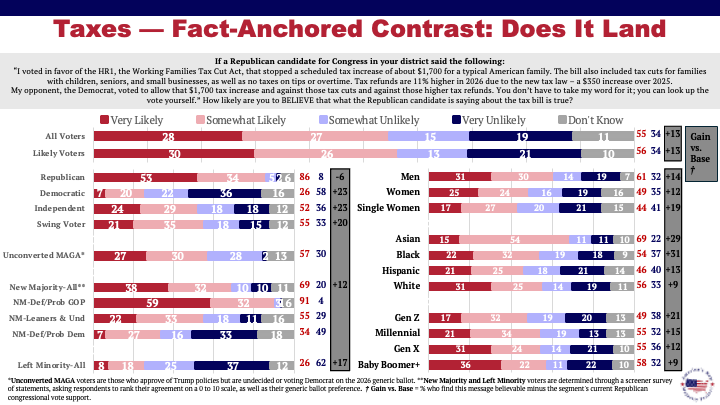
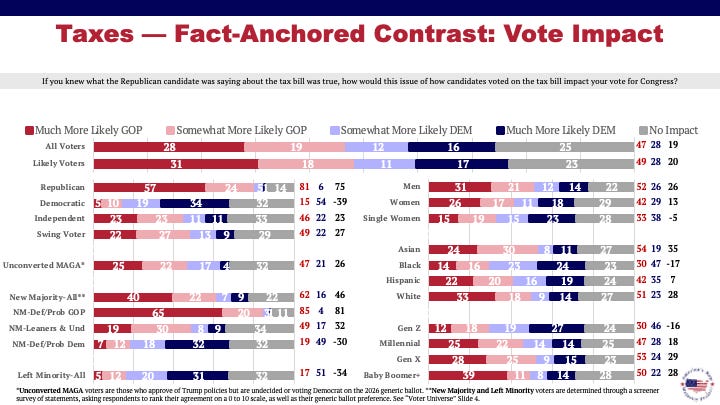
Taxes: Fact-Anchored Contrast Messages Beat Attack Messages by 5 Points Overall, 11 Points Among Independents
Of the five issues tested, taxes carried the second-highest congressional vote importance rating and a 30% deal-breaker rate making message discipline especially consequential. The test centered on HR1, the Working Families Tax Cut Act, with the contrast message citing the vote directly and naming specific household benefits. The 11-point Independent gap between the two formats is the clearest evidence in the taxes test that framing, not policy, is doing the persuasion work.
Fact-Anchored Contrast Message
Believability 55% / vote impact +19 net (all registered voters). Likely voters: 56% believability, +20 net.
Independents: +23 net vote impact—the decisive swing-segment number for this message.
Republicans +79 believability net; New Majority +49. Democrats the only negative segment (−32 believability net).
Attack Message
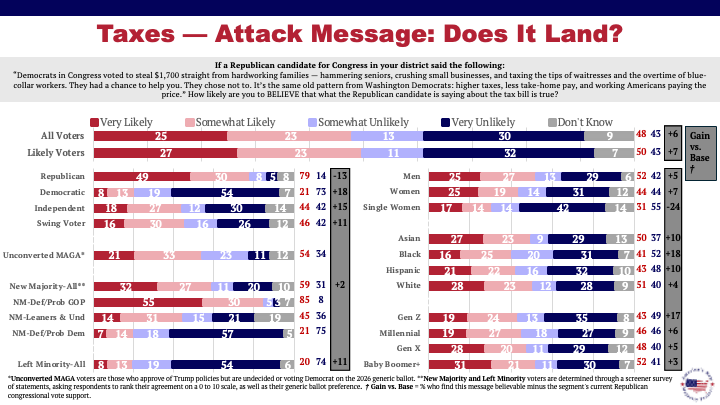
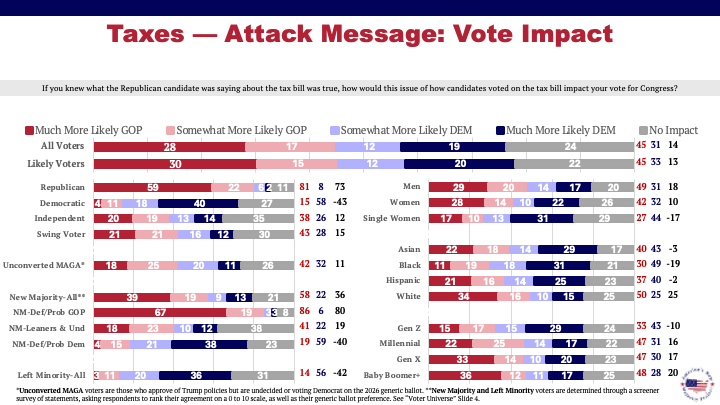
Believability 48% / vote impact +14 net—7 and 5 points below contrast respectively.
Independents: +12 net—an 11-point gap vs. contrast, the widest Independent framing differential in the taxes test.
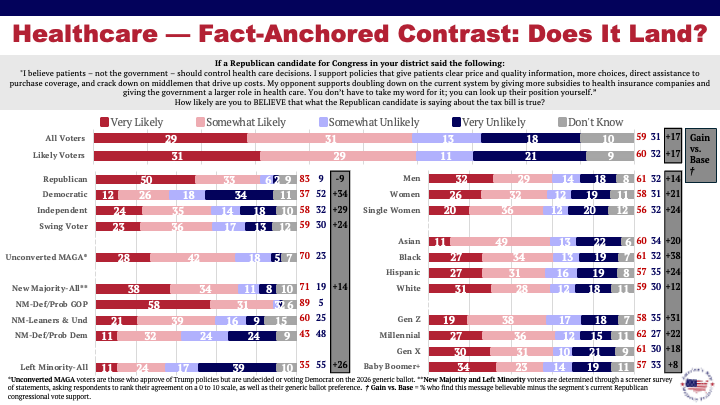
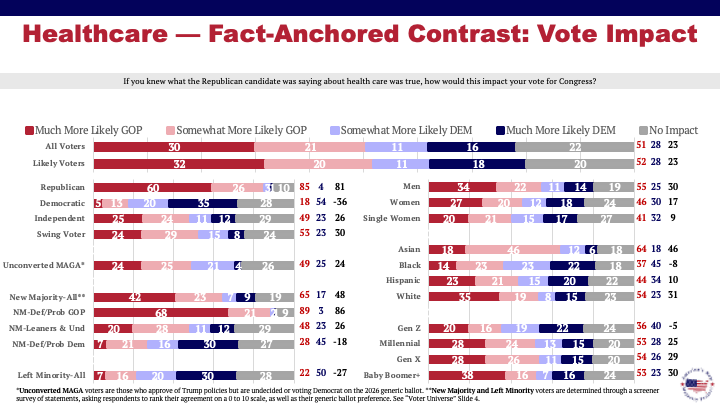
Healthcare: Highest Believability Gap in the Survey—and Strongest Overall Vote Impact
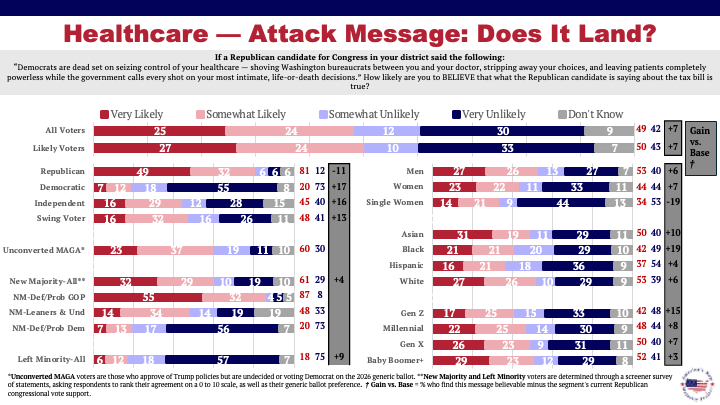
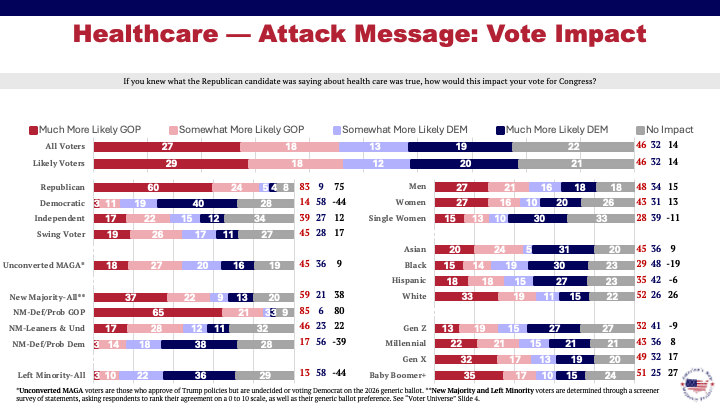
Healthcare ranked first in both congressional vote importance and deal-breaker rate, making it the highest-stakes issue in the survey for how a message is structured. The test framed the contrast around patient choice and a candidate’s position, while the attack asserted Democratic intent without a verifiable source. The results were the most decisive in the survey contrast outperformed attack by 9 points on overall vote impact and 14 points among Independents.
Fact-Anchored Contrast Message
Believability 59% / vote impact +23 net—tied for strongest contrast vote impact in the survey.
Independents: +26 net—the largest Independent vote-impact net for any contrast message across all five issues.
Democrats at −15 believability net—most competitive Democrat score in the survey, signaling unusual cross-partisan resonance on this frame.
Attack Message
Believability 48% / vote impact +14 net—11 and 9 points below contrast.
Independents: +12 net—a 14-point gap vs. contrast, the largest Independent framing differential in the entire survey.
Women’s Sports: Highest Believability Score in the Survey—Largest Independent Vote-Impact Net
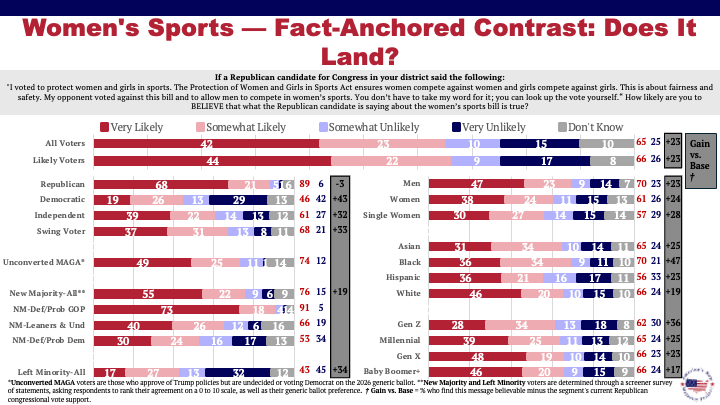
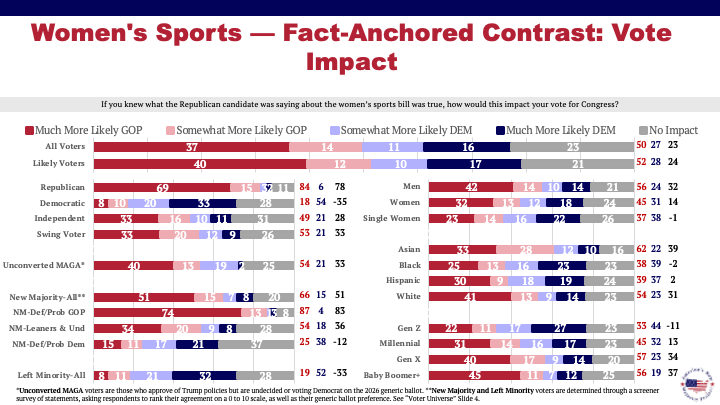
The test centered on the Protection of Women and Girls in Sports Act, with the contrast message citing the vote directly and the attack characterizing the opponent’s position without documentation. What separates this issue from the others is the bipartisan dimension. Democrats registered a positive believability net on the contrast message, the only time that occurred across all five issues. That opening disappeared entirely under the attack format, making message structure more consequential here than on any other issue tested.
Fact-Anchored Contrast Message
Believability 65% (highest in survey) / vote impact +23 net. Likely voters: 66% believability.
Independents: +28 net—the highest Independent vote-impact score in the entire survey.
Democrats net +4 believability—the only issue where Democrats are positive on a contrast message, indicating genuine bipartisan credibility on this frame.
Attack Message
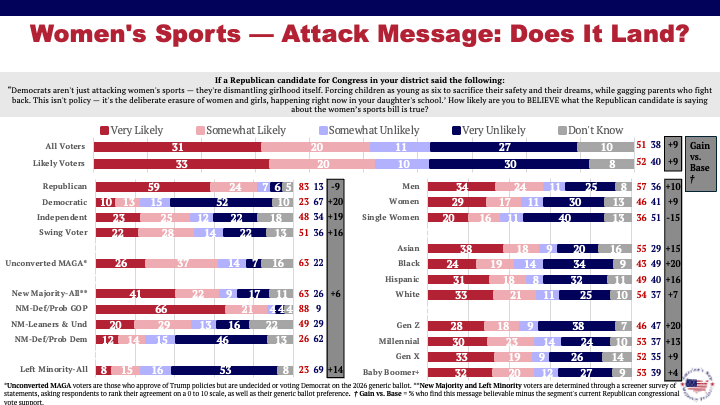
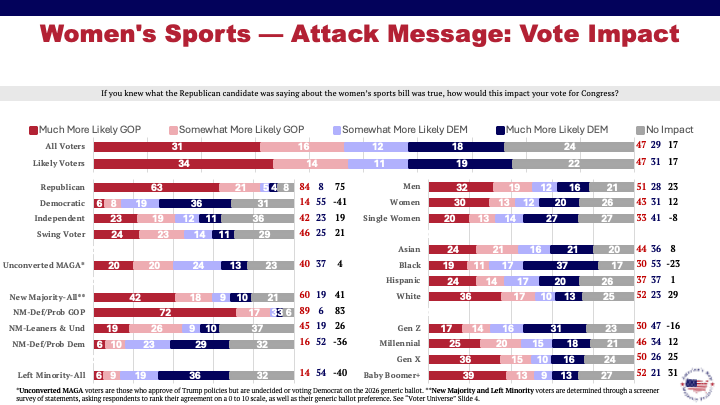
Believability 51% / vote impact +17 net—14-point believability gap vs. contrast.
Independents: +19 net— 9 points below contrast. Democrats swing to −43 believability net (vs. +4 for contrast)—attack eliminates the bipartisan opening entirely.
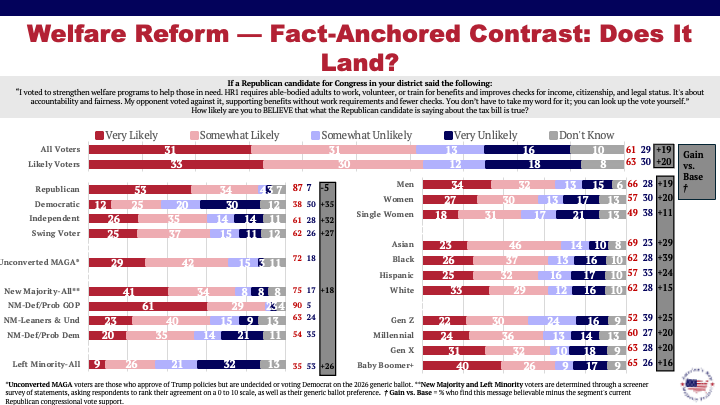
Welfare Reform: Highest Believability for Any Contrast Message—and Strongest Believability Gap
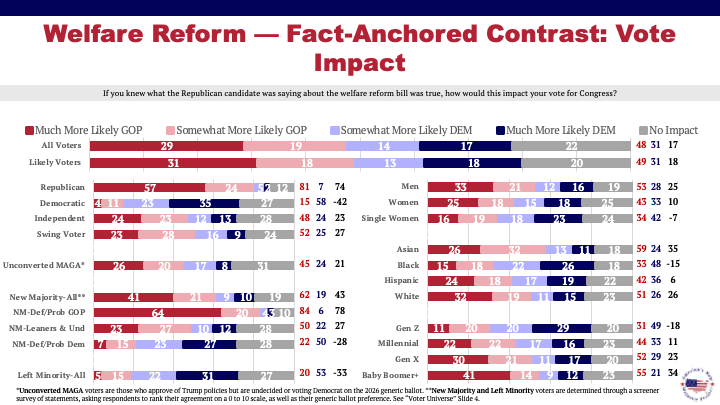
The test focused on HR1's work requirements and eligibility verification provisions, a frame that proved to have unusual cross-partisan credibility when delivered with factual anchoring. The contrast message produced the highest believability score in the entire survey at 61%, with Democrat-leaning voters returning a positive believability net, a result that held even as vote impact between the two formats nearly converged. The 11-point believability gap is the strongest credibility differential in the survey and the primary reason contrast remains the preferred long-term frame on this issue.
Fact-Anchored Contrast Message
Believability 61% (highest in survey) / vote impact +17 net. NM-Def/Prob Dem: +19 believability net—unusually strong cross-partisan credibility.
Democrats at −13 believability net—the least negative Democrat score in the survey; the work-requirement frame crosses party lines more than any other issue tested.
Independents: +23 net vote impact. Unconverted MAGA: +54 believability net, +21 vote net.
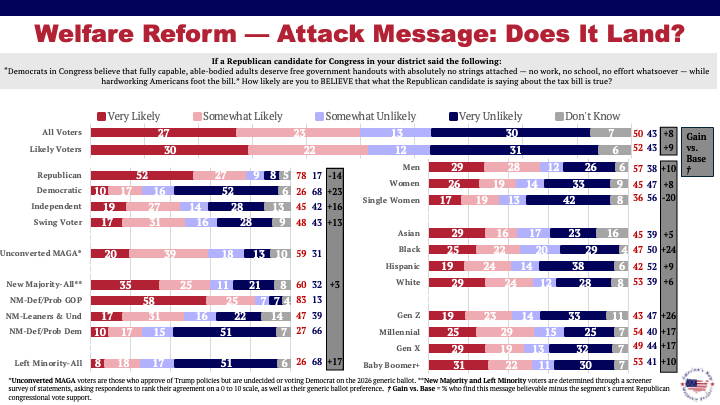
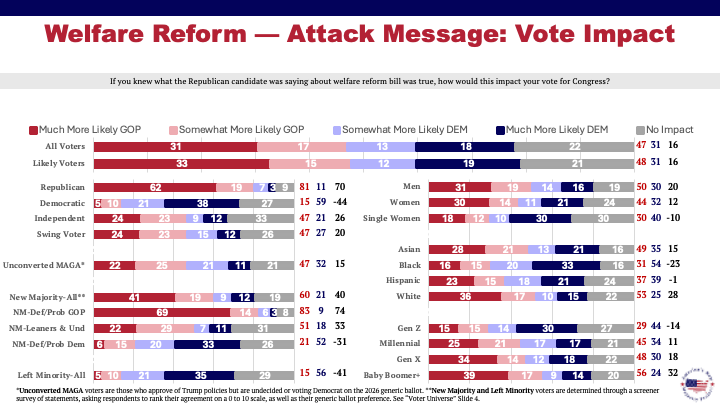
Attack Message
Believability 50% / vote impact +16 net—vote impact nearly converges with contrast (+17), but the 11-point believability gap persists.
Independents: +26 net—the one issue where attack edges contrast among Independents (+23 for contrast); the credibility deficit remains regardless.
Republican believability drops to 78%—the lowest R score for any message in the survey; “handouts” framing undercuts credibility even within the base.
Immigration: Contrast Leads on Believability; Vote Impact Converges Overall
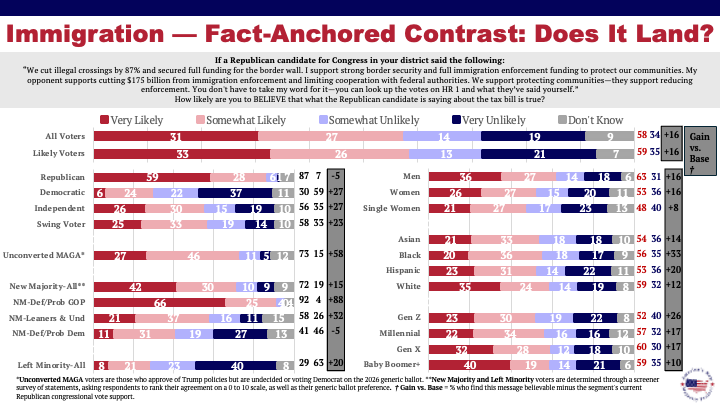
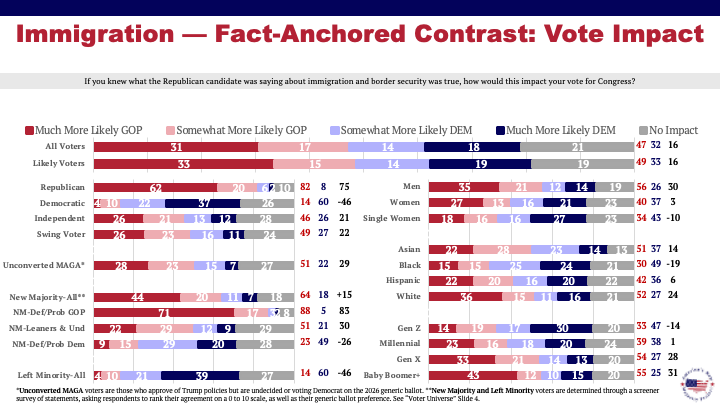
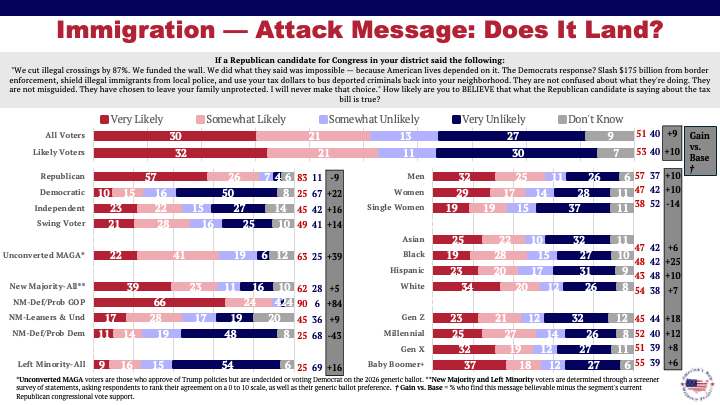
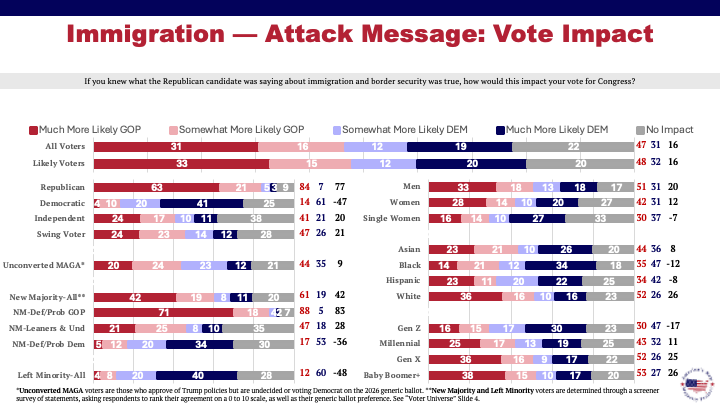
On immigration, the contrast message gave voters a specific, verifiable fact: an 87% reduction in illegal crossings tied directly to a congressional vote. Both messages moved voters at the same rate but that doesn't mean they worked equally well. Voters were 6 points more likely to believe the contrast message was true. That gap matters because a voter who trusts what they're hearing today is more open to the next message they receive. Even when two messages produce the same immediate result, the one voters believe is the one that keeps working.
Border security and enforcement funding; 87% reduction in illegal crossings cited with HR1 votes as the verifiable anchor.
Fact-Anchored Contrast Message
Believability 58% / vote impact +16 net. NM-Def/Prob GOP: 92% believability / +88 net—the highest single-segment score in the entire survey.
Independents: +21 net vote impact.
Where voter impact ties with attack, the credibility advantage still compounds over a campaign cycle—the verification offer builds cumulative trust that a pure attack cannot.
Attack Message
Believability 52% / vote impact +16 net—the only issue where attack achieves overall parity on vote impact; a 6-point believability gap remains.
Independents: +20 net—1 point below contrast, essentially even.
Democrats: −47 net vote impact—the deepest Democrat negative in the survey; attack framing maximally hardens partisan lines on immigration.
The Bottom Line
Message structure is a choice and this survey shows that it is a consequential one. Across five issues, two message formats, and every voter segment measured, the structural difference between a fact-anchored contrast message and a pure attack produced consistent, replicable differences in both believability and vote impact. The contrast format did not win because the issues favored it. It did not win because the political environment was unusually receptive. It won because a verification offer and a positive candidate position change how voters process a claim from assertion to evidence.
The practical implication is straightforward. Anchor the message in a documented record. Name what the candidate did and why it matters. Draw the contrast to the opponent using the same verifiable standard. Invite the voter to check it. That structure outperformed the alternative on every issue in this survey and the gap was largest precisely among the voters who decide competitive outcomes: Independents, cross-pressured partisans, and high-salience issue voters who are weighing credibility as much as policy.
There is no issue in this data where the attack format is the better choice for moving persuadable voters. That is not a preference. It is the finding.
What’s Next
We will have more analysis on this messaging survey over the next few weeks along more on our 250th celebrations of the Nation.
We want to hear from you! We not only enjoy hearing from our subscribers, but we also use your feedback to bring you the most recent and engaging policy information available. Share how you’re using this data or tell us what new insights you’d like to see.
Get in touch with us anytime, and let’s make an impact together!
this is very interesting and helpful. however, on my screen I could not read the "attack" message or the "contrast" message, if one was provided, even as an exemplar. I think the discussion can be better understood if examples are provided even though much of the readership can likely create the attack message (you're a racist, you're a nazi, you're a sexist, you're ignorant, etc.) and, based on the subject matter involved (DEI, tolerance or support of Israel, biological men playing in women's sports and invading women's spaces, or a recitation of historical facts), the contrast message. Still, exemplar's of the various messages would be helpful.