


Key Takeaways
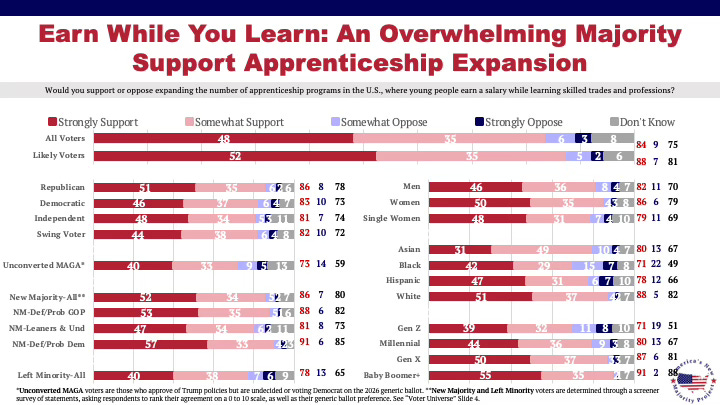
There is overwhelming, bipartisan support for expanding apprenticeship programs, with Republicans, Democrats, and Independents all in strong agreement.
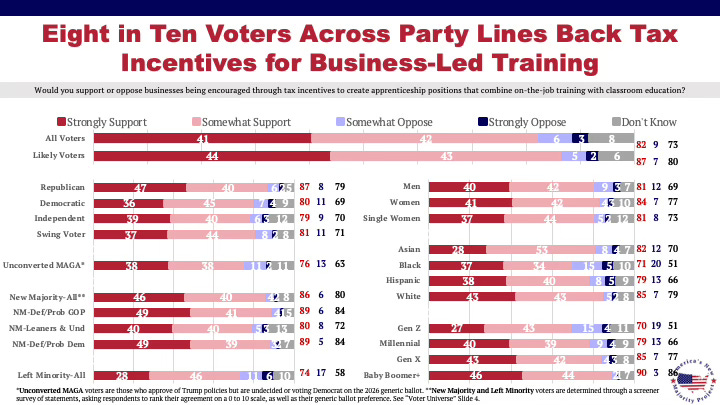
Broad, cross-partisan consensus exists for offering tax incentives to businesses that create apprenticeship positions.
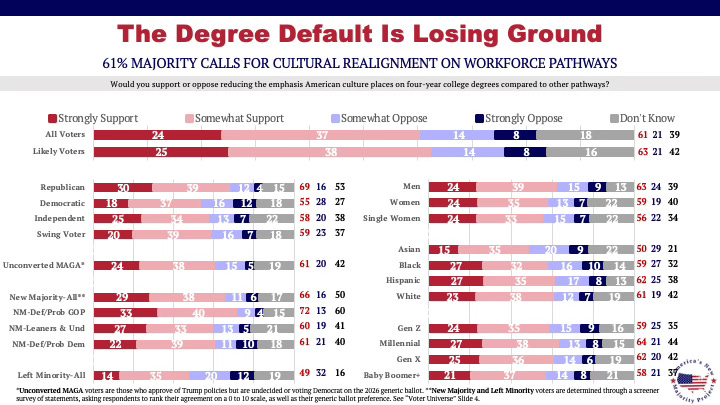
A majority of Americans support shifting cultural emphasis away from four-year degrees toward alternative pathways.
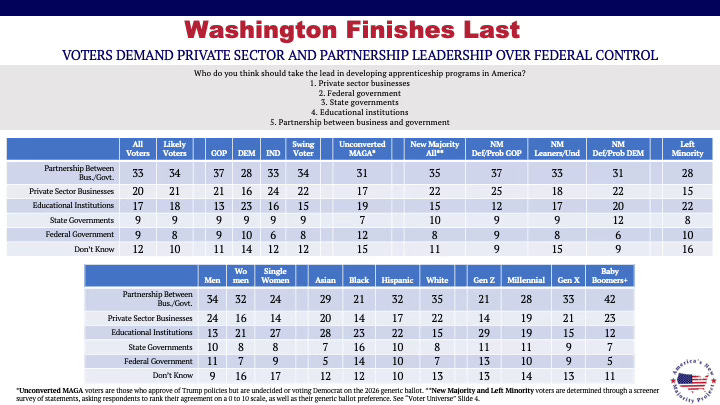
Americans strongly prefer private-sector or public-private partnership leadership in developing apprenticeship programs, with the federal government ranking last as the least preferred option.
Voters overwhelmingly support expanding apprenticeship programs, tax incentives for businesses that create them, and shifting away from the four-year degree as the default pathway to the middle class.
Why it Matters
The timing of this sentiment shift is no accident. Student loan debt has reached crisis levels, and AI is rapidly reshaping the labor market—displacing white-collar jobs once considered degree-dependent while creating urgent demand for skilled tradespeople who can build and maintain the physical infrastructure AI cannot replace. As the cost of a four-year degree climbs and its return grows less certain, voters are making a more clear-eyed calculation about what actually prepares people for the economy ahead.
How to Use This Data
This data offers advocates a clear, evidence-based foundation. Bipartisan supermajorities support expanding apprenticeship programs, incentivizing business-led training via the tax code, and reducing the cultural primacy of four-year degrees. Voters reject federal leadership in implementation at 9%, with 53% favoring private-sector or partnership models.
Advocates can frame apprenticeship expansion as a market-driven, community-based workforce solution, which has the broadest public support.
View the full data by clicking below.

84% Support Expanding Apprenticeship Programs
86% of Republicans, 83% of Democrats, and 81% of Independents support expanding apprenticeships where young people earn a salary while learning skilled trades.
Among target voters, 73% of Unconverted MAGA voters (those who approve of Trump’s policies but are undecided or voting Democrat on the generic ballot) and 81% of New Majority voters who are leaning or undecided support expanding apprenticeship programs.
82% Back Tax Incentives for Business-Led Apprenticeships
87% of Republicans, 80% of Democrats, and 79% of Independents support encouraging businesses through tax incentives to create apprenticeship positions combining on-the-job training with classroom education.
Unconverted MAGA: 76% support / New Majority Leaners (Lean R/Lean D/Und.): 80% support.
61% Say Reduce the Cultural Emphasis on Four-Year Degrees
69% of Republicans, 55% of Democrats, and 58% of Independents support reducing the emphasis on four-year degrees compared to other pathways.
Only 21% oppose. 18% are undecided.
Who Should Lead Apprenticeship Development?
Business-Government Partnership: 33% (top choice).
Educational Institutions: 17%. State Governments: 9%. Federal Government: 9% (last).
Republicans favor private business (21%) and business-government partnership (37%). Democrats split between educational institutions (23%) and business partnerships (28%).
The Bottom Line
Americans are reconsidering that a four-year college degree is the only path to a good career. Polling shows broad support for expanding apprenticeship programs where young people earn while learning trades, with voters wanting tax breaks for businesses creating these opportunities. Rising college costs, student debt, and AI’s impact make trade skills more valuable.
Importantly, voters prefer businesses and communities lead this effort over the federal government.
What’s Next
Stay tuned—in the coming days, we will be posting more findings from our latest poll.
We want to hear from you! We not only enjoy hearing from our subscribers, but we also use your feedback to bring you the most recent and engaging policy information available. Share how you’re using this data or tell us what new insights you’d like to see.
Get in touch with us anytime, and let’s make an impact together!
I agree that apprenticeships should be encouraged and supported. However, I also am in favor of institutions of higher education should be accountable for graduates who are not employed in their areas of their degree education if they are not employed within 18 months of graduates.