

Key Takeaways
73% of voters say individuals should control their own health data
Voters are most comfortable sharing data with their doctors
Wearable data integration is wanted — on patients’ terms
Younger voters lead on wearable adoption but share the same control instinct
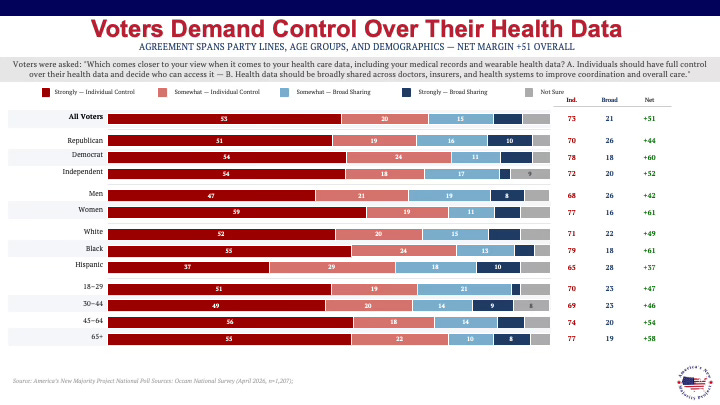
Americans are deeply protective of their personal health information and a new poll from America’s New Majority Project makes clear just how strong that instinct is. When asked whether health data should be under individual control or broadly shared across the health care system, nearly three in four voters chose individual control. The consensus spans party lines, age groups, and regions.
Why it Matters
Health data is rapidly becoming one of the most valuable and sensitive categories of personal information. Wearable devices, electronic medical records, and AI-powered diagnostic tools are generating unprecedented volumes of patient data — and the rules governing who can access that data are still being written. This polling shows that voters have a strong and clear prior: they want to be in the driver’s seat. Policymakers and health systems that treat patient data as a shared resource risk a significant political and public trust backlash.
How to Use This Data
Health data legislation should prioritize patient agency and consent. Opt-in, patient-controlled data sharing is likely to earn broad support, while insurer access without explicit consent should be treated cautiously. Voters may accept sharing data for discounts, but not for premium increases. The findings also support clear, accessible health data summaries that patients can easily understand and manage.
Voters Demand Individual Control Over Health Data By A 3-To-1 Margin
73% of voters say individuals should have full control over their health data and decide who can access it — vs. only 21% who favor broad sharing across doctors, insurers, and health systems.
53% strongly agree that individuals should control their own health data making individual control not just a plurality position but a commanding one.
Only 7% strongly favor the broad-sharing model, and just 15% lean that direction, for a combined 21.2%.
The margin is consistent across age groups: 70% of 18–29-year-olds, 69% of 30–44-year-olds, 74% of 45–64-year-olds, and 77% of voters 65+ all favor individual control.
Voters Will Share Data With Their Doctor But Draw The Line At Insurers And Companies
53% are comfortable sharing wearable health data with their doctor for their own care the only use case that clears a majority.
Sharing for personalized health recommendations earns 42% comfort a solid second, but still well below the doctor-sharing figure.
Receiving health data in a clear, understandable format is what 41% of voters want signaling strong demand for patient-facing data literacy tools.
Only 14% are comfortable with their wearable data being used by companies to develop products, and just 11% approve of insurance company access.
19% say “none of the above,” unwilling to share their wearable data for any of the listed purposes a sizable result from those who want a complete data lockdown.
Voters Want Wearables In Their Health Care On Their Own Terms
51% of voters use a health wearable (36% regularly, 15% occasionally) — making this a mainstream technology, not a niche one.
54% prefer a patient-controlled model for their health data (where they can easily see, correct, and control who accesses it), compared to 38% who prefer a broadly shared model.
By party, the patient-control preference holds across the board: 57% of Republicans, 53% of Democrats, and 54% of independents favor the patient-control data model.
Despite wearable adoption, voters still trust their doctor first: 56% say they follow their doctor’s advice for day-to-day health decisions, vs. just 16% who primarily follow their wearable or health app.
The Bottom Line
The numbers here are unusually lopsided for a health care question. At 73%, individual control of health data is not just a majority view it is near consensus.
The political opportunity is clear, championing patient data rights is a winning issue across the coalition. Policies that give patients real control easy access, correction rights, and meaningful consent before any sharing will find broad support. Policies that allow institutions to access or monetize patient data without clear, affirmative consent will face significant backlash.
What’s Next
We will have more analysis on voter attitudes about pressing issues over the next few weeks as well as updated responses to questions regarding the 250th celebrations of the Nation.
We want to hear from you! We not only enjoy hearing from our subscribers, but we also use your feedback to bring you the most recent and engaging policy information available. Share how you’re using this data or tell us what new insights you’d like to see.
Get in touch with us anytime, and let’s make an impact together!