


On a number of issues involving healthcare, immigration, gender identity, and taxes, Democratic lawmakers in Congress are not only out of step with the American people—they are often to the left of many self-identified liberals.
Key Takeaways
Many Democratic policy positions are viewed as “crazy” by voters across the political spectrum, including majorities of self-identified liberals.
The strongest areas of agreement span healthcare, taxes, immigration, and parental rights, where liberal, moderate, and conservative voters often reach remarkably similar conclusions.
The political divide on these issues is often less about left versus right and more about voters versus political elites.
Democrats may struggle to win independent and swing voters if they remain associated with positions that even many liberal voters reject.
On a number of issues involving healthcare, immigration, gender identity, and taxes, Democratic lawmakers in Congress are not only out of step with the American people they are often to the left of many self-identified liberals.
Why it Matters
Midterm elections typically favor the party out of power. However, if Democrats remain associated with positions that large majorities of voters—and often majorities of liberals—view as “crazy,” they may struggle to win the independents needed for a successful election.
How to Use This Data
This data identifies the issues where fact-based contrast messages are most likely to resonate with swing voters because they expose the largest gap between Democratic elected officials and the broader electorate.
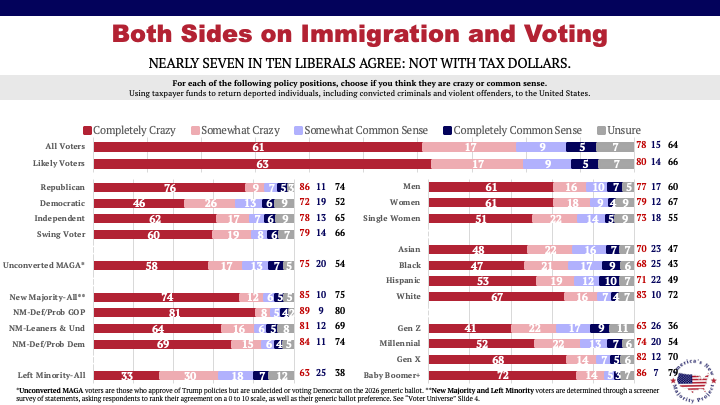
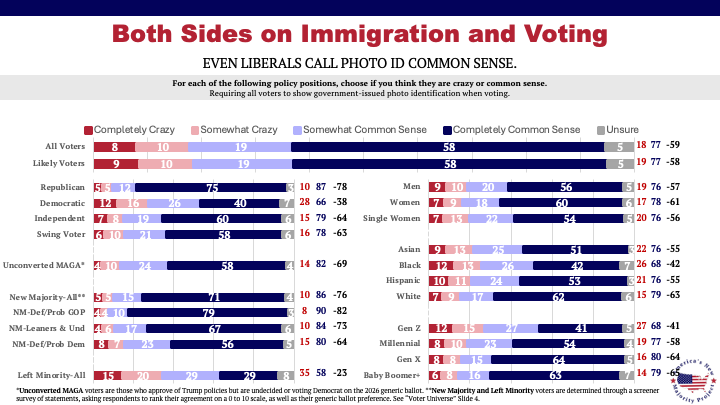
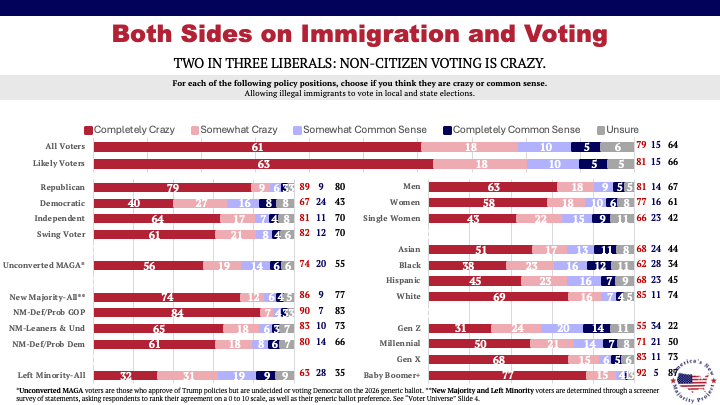
Immigration and Voting: Voters Oppose Illegal Immigrant Voting and Support Photo ID
Letting illegal immigrants vote in local and state elections: 79% overall crazy. Liberals: 67%. Moderates: 77%. Conservatives: 92%.
Using taxpayer money to bring back immigrants deported for criminal records: 78% overall crazy. Liberals: 69%. Moderates: 76%. Conservatives: 91%.
Requiring photo ID to vote: 77% say this is common sense. Liberals: 68% say it is common sense.
Requiring proof of citizenship to register to vote: 79% common sense overall. Liberals: 71% common sense. A 24-point gap with conservatives, but liberals are still on the majority side.
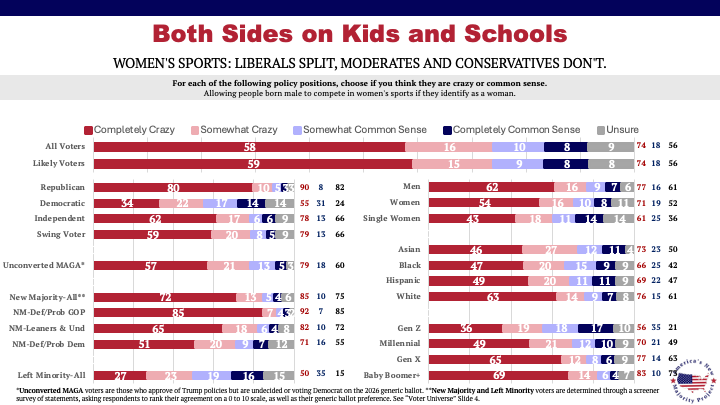
Gender Ideology and Schools: Voters Support Parents Rights and Integrity of Women’s Sports
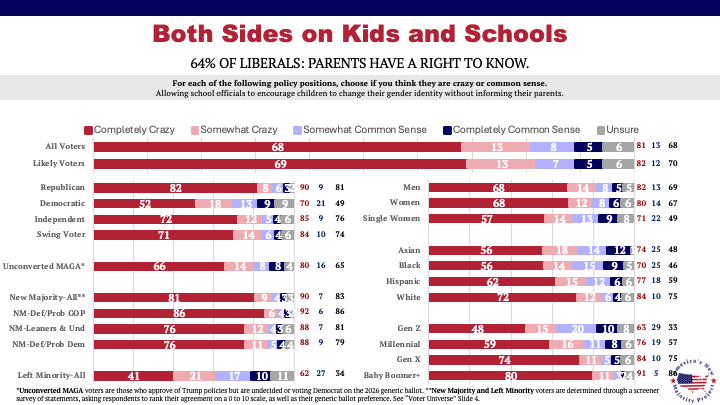
Letting school officials encourage a child to change their gender identity without telling the parents: 81% overall crazy. Liberals: 64%. Moderates: 84%. Conservatives: 94%.
Allowing people born male to compete in women’s sports: 74% overall crazy. Liberals: 48%. Moderates: 77%. Conservatives: 93%. This is the only issue where liberals are closely divided, but moderates oppose it by a wide margin.
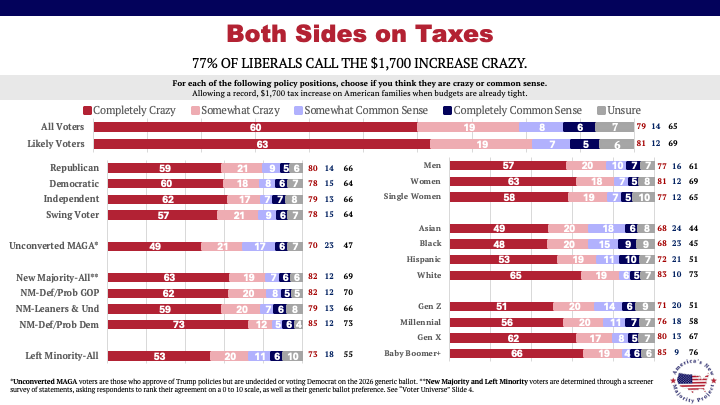
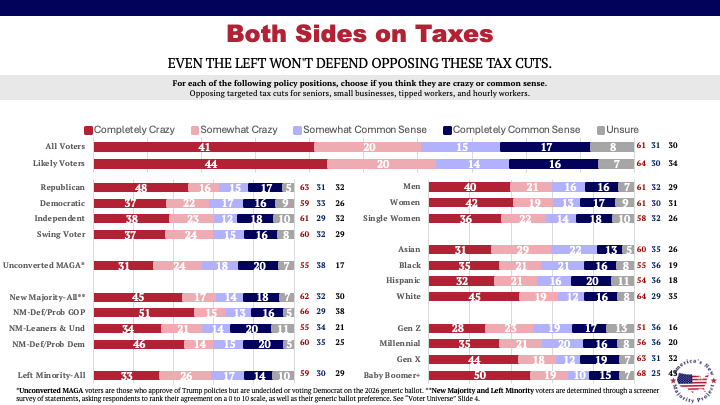
Taxes: Voters Reject Allowing Tax Increases; Support Middle Class Tax Cuts
Allowing a $1,700 tax increase on American families: 79% overall crazy. Liberals: 77%. Moderates: 76%. Conservatives: 85%.
Opposing tax cuts for seniors, small businesses, and tipped and hourly workers: 61% overall crazy. Liberals: 60%. Moderates: 59%. Conservatives: 67%.
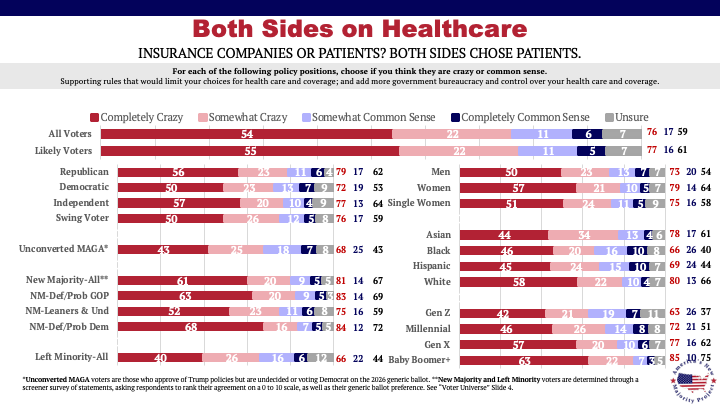
Healthcare: Voters Want More Choice and Less Money for Insurance Companies
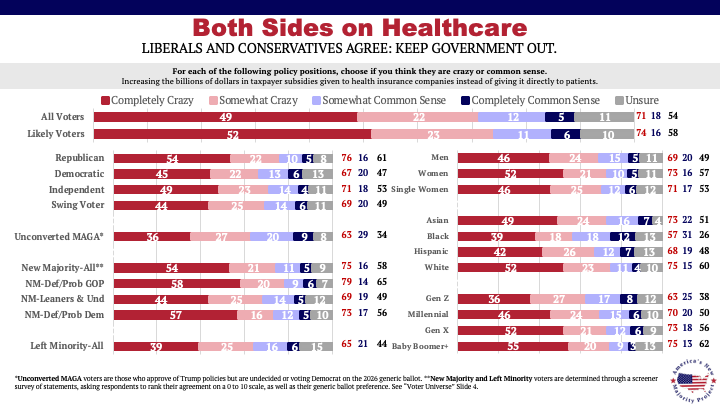
Rules that limit your healthcare choices and add government control: 76% overall crazy. Liberals: 71%. Moderates: 73%. Conservatives: 85%.
Sending more taxpayer money to insurance companies instead of patients: 71% overall crazy. Liberals: 71%. Moderates: 66%. Conservatives: 78%.
The Bottom Line
Across a wide variety of issues, the largest divide is not between liberal and conservative voters. It is between Democratic elected officials and the voters they claim to represent.
Identifying where Democratic positions diverge from public opinion is only half the equation; the messaging study shows which half moves votes. Fact-anchored contrast messages that cite a documented record and invite verification consistently outperformed attack messages on believability and vote impact, with no issue where attack was the better choice for persuadable voters.
On healthcare and taxes, contrast messages produced the strongest Independent movement of any issue tested, the same categories where this survey shows voters converging on common sense. The data above shows where elected officials and the public have drifted apart; the messaging research shows how to turn that gap into votes.
*Source: America’s New Majority Project / Gingrich 360 / McLaughlin & Associates. National survey of 2,000 registered voters, May 14–18, 2026. Ideology figures from Banner 6; intensity figures from Banner 1 total sample.
What’s Next
We will have more analysis on this messaging survey over the next few weeks along more on our 250th celebrations of the Nation.
We want to hear from you! We not only enjoy hearing from our subscribers, but we also use your feedback to bring you the most recent and engaging policy information available. Share how you’re using this data or tell us what new insights you’d like to see.
Get in touch with us anytime, and let’s make an impact together!
I think every American should see this:
https://rairfoundation.substack.com/p/listen-to-the-911-architect-in-his?
Certainly an ironic time to suggest government run health care given all the recent Fauci-related news illustrating government abuse and incompetence. Interesting article today from Jonathan Turley that fits the subject well: https://jonathanturley.org/2026/08/17/for-the-american-left-nothing-succeeds-as-much-as-failure/