

Key Takeaways
Americans take Iran at its word. 55% say Iran’s leaders mean it when they chant “Death to America” — nearly twice the 30% who call it rhetoric.
The belief crosses the center. 69% of Republicans, 68% of seniors, and 62% of independents take the threat literally; even 39% of Democrats agree.
Voters expect the worst if America backs off. If the U.S. stops, 25% expect Iran to build a nuclear weapon and only 13% think life in Iran improves.
Belief converts into a mandate. 90% of voters support at least one form of action; only 10% choose none, and 67% see a nuclear Iran triggering an arms race.
The audience is already listening. 85% follow the conflict, and support for pressure plus diplomacy holds across Republicans, independents, and Democrats.
Why It Matters
Because voters see the threat as real, they expect the worst if the U.S. backs off. If America ends military action and lifts sanctions, voters say Iran would build a nuclear weapon (25%), attack a U.S. ally (24%), or target Americans at home or abroad (24%). Just 16% expect Iran to resume negotiations, and 13% think ordinary Iranians’ lives would improve. Two-thirds (67%) also find it convincing that a nuclear Iran would trigger a regional arms race. The public understands the stakes.
How To Use This Data
Lead with a threat voters believe: “Death to America” and the nuclear danger. This support translates into a mandate: 90% back at least one form of pressure on Iran; only 10% reject all options. Frame the mission around keeping the Strait of Hormuz open, maintaining sanctions, and securing concrete terms—goals a cross-party majority supports.
Americans Take Iran at Its Word
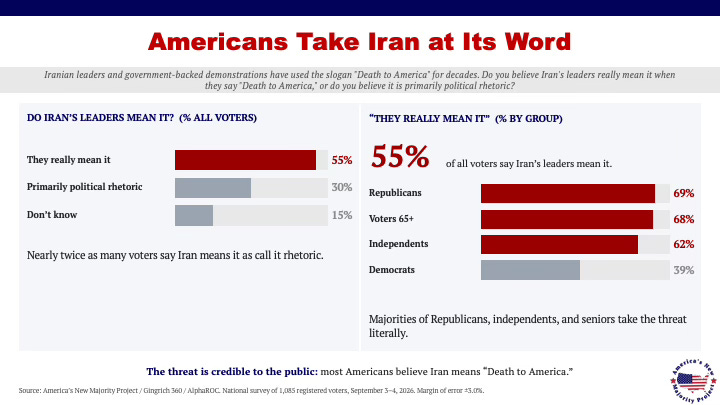
A majority of voters 55% say Iran’s leaders really mean it when they chant “Death to America.” Just 30% call it primarily political rhetoric; 15% are unsure.
The belief runs through the political center: 69% of Republicans, 68% of voters 65 and older, and 62% of independents take the threat literally. Even among Democrats, 39% say Iran means it.
Voters expect the worst if America walks away. If the U.S. ended military action and lifted sanctions, more expect Iran to build a nuclear weapon (25%), attack a U.S. ally (24%), or attack Americans (24%) than expect any peaceful result.
Few see an upside to backing off: only 16% think Iran would return to negotiations and only 13% think conditions for ordinary Iranians would improve.
The danger is credible on its own terms. 67% of voters find it convincing that a nuclear Iran would trigger a regional arms race, including 85% of Republicans and 68% of independents.
Belief Converts Into a Mandate for Action
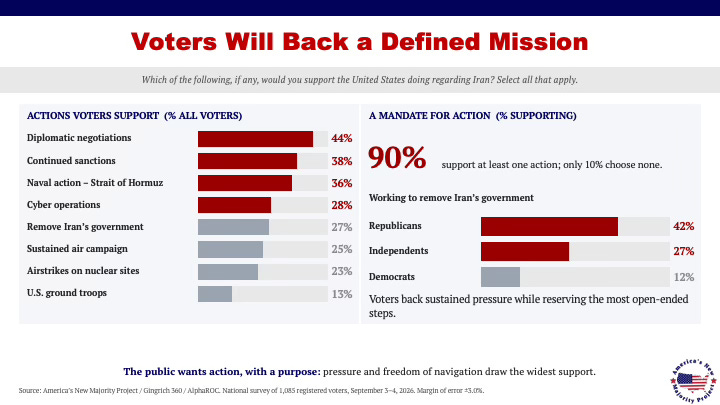
90% of voters support at least one form of action on Iran; only 10% choose none.
The widest support is for sustained pressure: diplomatic negotiations (44%), continued economic sanctions (38%), naval action to keep the Strait of Hormuz open (36%), and cyber operations (28%).
Voters back the pressure track while reserving the most open-ended steps a sustained air campaign (25%), airstrikes on nuclear sites (23%), and U.S. ground troops (13%).
Support for removing Iran’s government is led by Republicans (42%), with independents at 27% and Democrats at 12% room to grow as the case is made.
The takeaway is a public ready to act with a purpose: pressure and freedom of navigation are the actions voters most want to see used against a threat they take seriously.
The Audience Is Already Listening
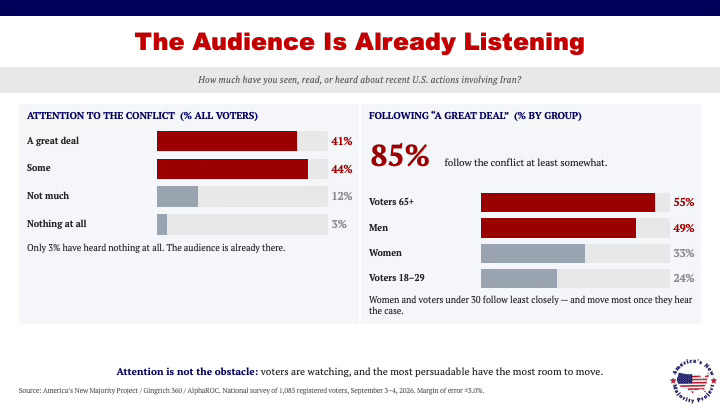
41% of voters have seen, read, or heard a great deal about recent U.S. actions involving Iran and 44% have heard some — 85% in total.
Only 3% have heard nothing at all. The audience is already there.
Attention runs highest among the voters most receptive to the threat message: 55% of voters 65 and older and 49% of men follow a great deal.
The voters with the most room to move — women (33%) and voters under 30 (24%) — follow least closely today, and are the ones who shift most once they hear the case.
Attention does not track party: Republicans (43%), Democrats (42%), and independents (40%) all follow closely — a shared audience for a shared argument.
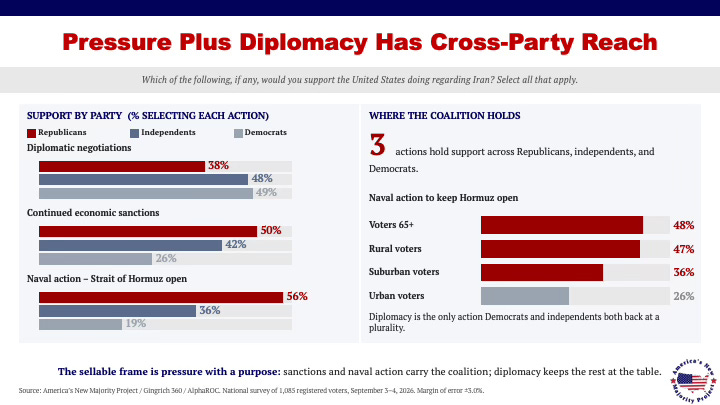
Pressure Plus Diplomacy Has Cross-Party Reach
Three actions hold support across every partisan group, giving the case a durable foundation.
Diplomatic negotiations are backed by a plurality of Democrats (49%) and independents (48%), with Republicans at 38%.
Continued sanctions carry the right and center: 50% of Republicans and 42% of independents, with Democrats at 26%.
Naval action to keep the Strait of Hormuz open draws 56% of Republicans and 36% of independents; it is strongest among voters 65 and older (48%) and rural voters (47%).
Older voters anchor the coalition: 54% of voters 65 and older support continued sanctions and 48% support naval action — the highest of any age group on both.
The Bottom Line
The American people already believe the core of the case. A majority say Iran means “Death to America,” most expect a nuclear Iran and further attacks if the United States backs off, and 90% support at least one form of action to stop it. 85% are following the conflict, and support for pressure holds across Republicans, independents, and Democrats alike.
The foundation is in place, voters see the threat as real and want it met. The task now is to name the mission in the terms they already accept keeping the Strait open, holding the sanctions, and stopping Iran’s bomb and lead the national debate that turns a believing public into a decisive majority.
AlphaROC conducted a national survey for Gingrich 360 among 1085 registered voters on September 3-4th, 2026. All interviews were conducted online. Survey invitations were randomly distributed, with demographic balances approximating U.S. census benchmarks. The sample of 1085 registered voters carries a margin of error of ±3.0% at the 95% confidence level.
What’s Next
We have a new post on some exciting data from our September survey on Big Government Socialism and how American voters view its policies as we approach the 2026 midterm elections.
We’d love to hear your thoughts! Please share what topics you’d be interested in regarding where American voters stand on various issues.