

Key Takeaways
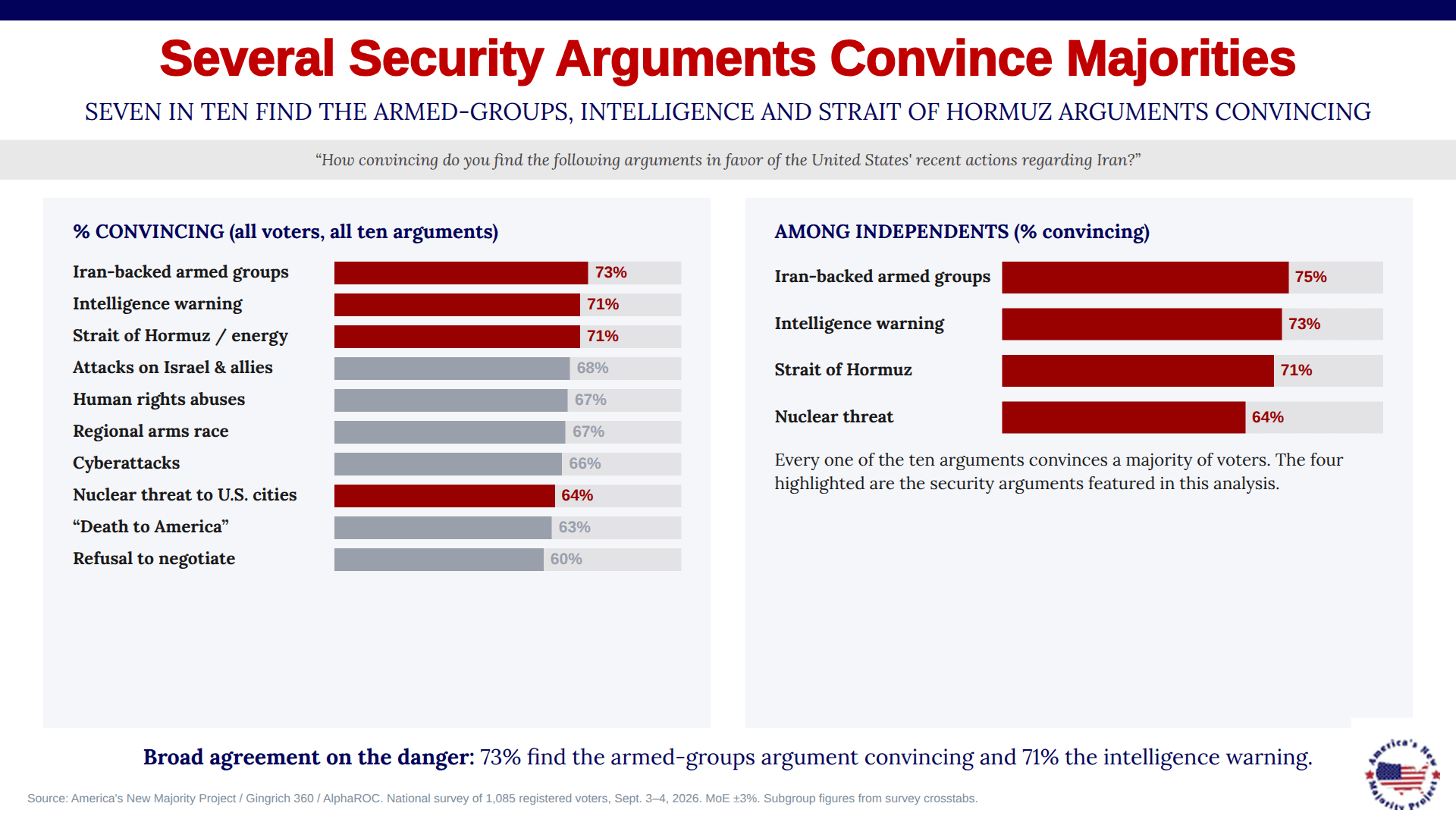
Security arguments convince majorities. 73% find the armed-groups argument convincing, 71% the intelligence warning, 71% the Strait of Hormuz, and 64% the nuclear threat.
The intelligence warning reaches beyond the base. 73% of independents and 57% of Democrats find it convincing.
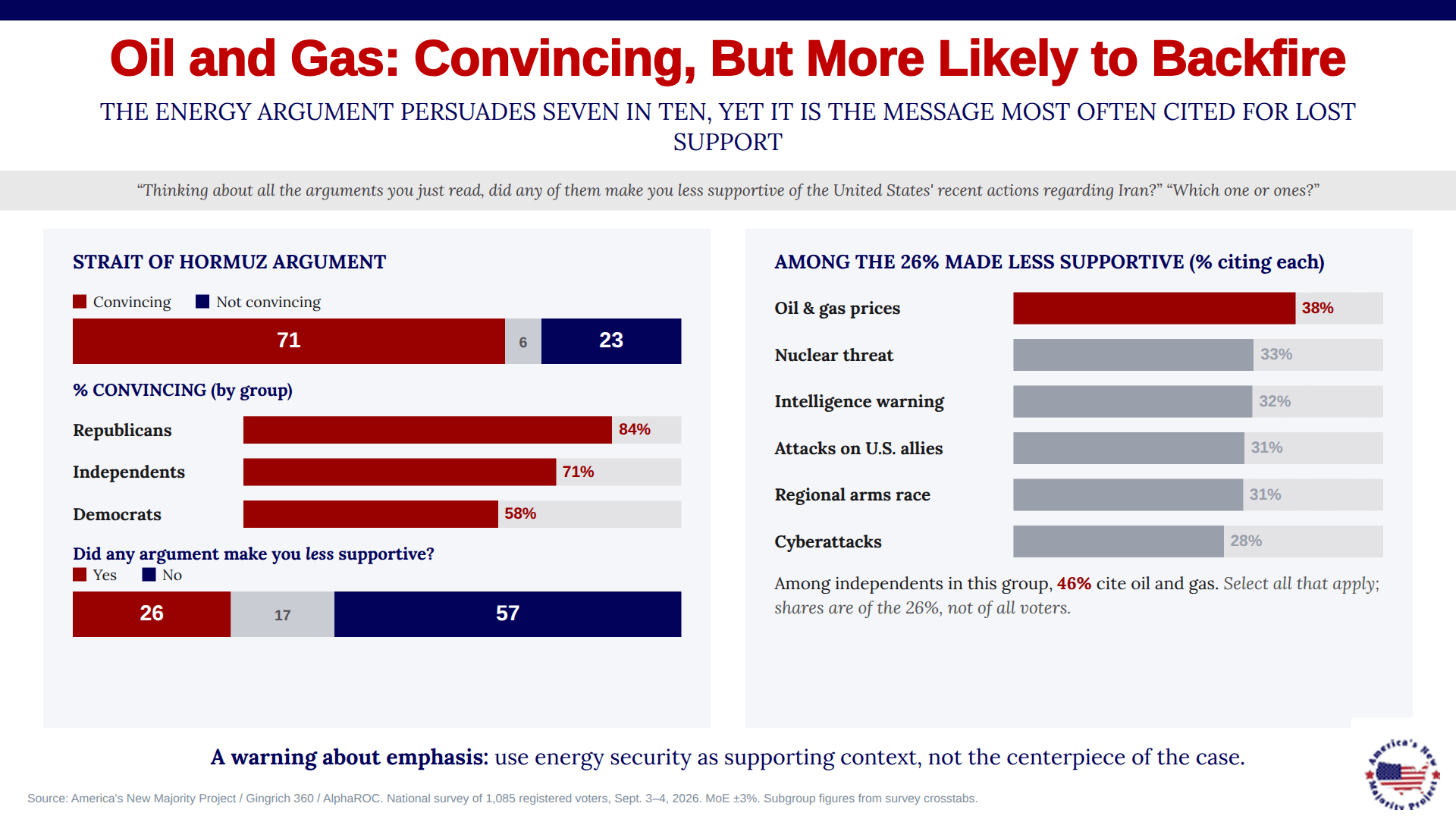
Oil and gas carries a risk. Among the 26% who say an argument made them less supportive, 38% cite oil and gas, more than any other message.
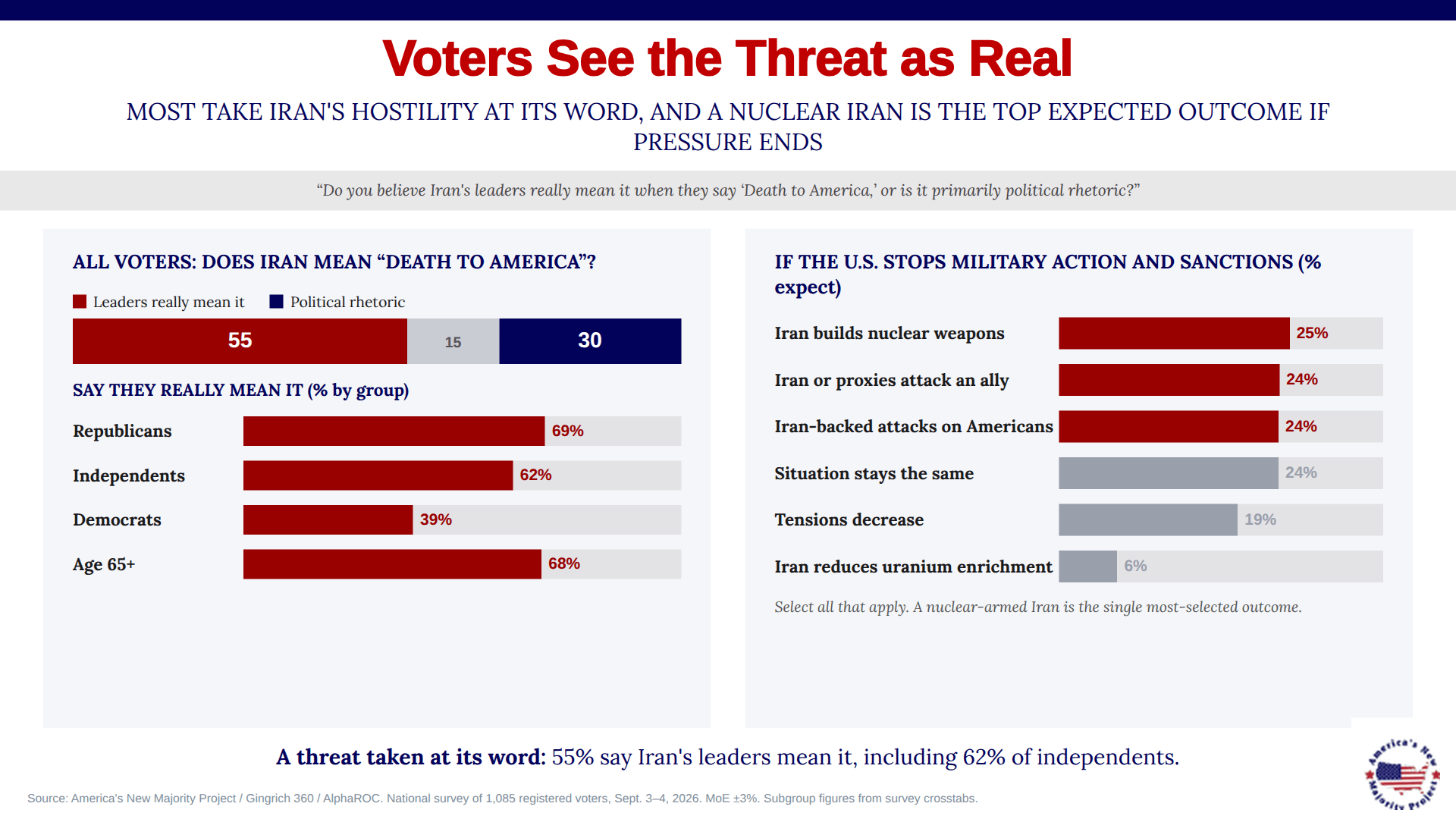
Voters take Iran at its word. 55% say its leaders mean “Death to America.
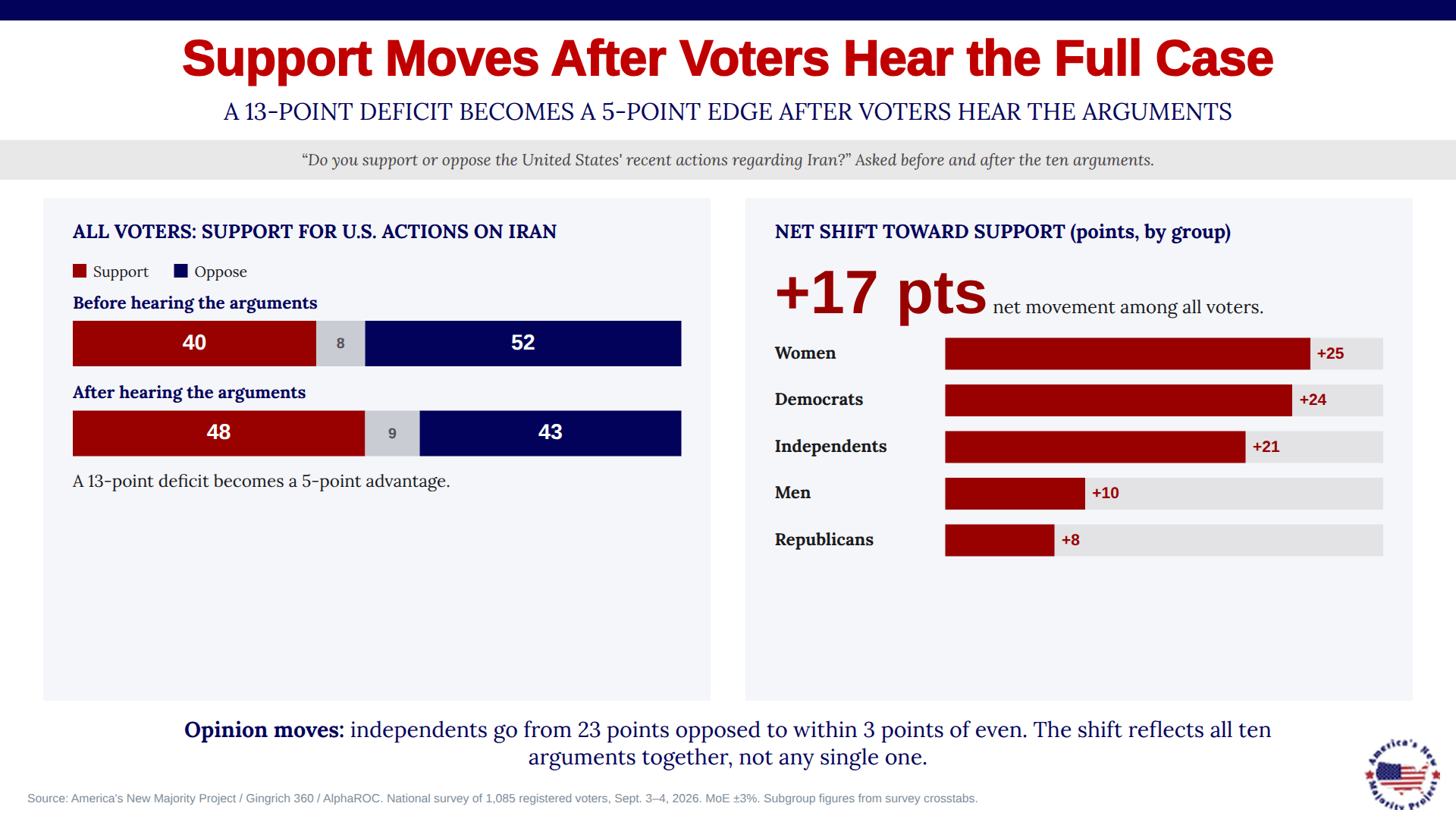
Support moves after the full case. Opinion shifts from 40% support and 52% oppose to 48% and 43%, a 17-point net shift that can’t be credited to any single argument.
Why It Matters
Voters start out skeptical. Before hearing any arguments, 40% support recent U.S. actions regarding Iran and 52% oppose. Asked to choose the single most convincing of ten arguments, 17% pick the nuclear threat and 13% pick intelligence warnings — together 30%, well ahead of any other option.
After the full set of arguments, support leads 48% to 43%. Because the ten arguments were presented together, voters can't credit any single one, but they most often put the nuclear and intelligence arguments first.
How To Use This Data
Lead with the nuclear threat and back it with the intelligence warnings. The nuclear argument is voters’ most common first choice, while the intelligence warnings have the broadest reach convincing 71% of all voters, 73% of independents, and a majority of Democrats. Use the intelligence warnings as the proof point that the danger reaches Americans at home.
Several Security Arguments Convince Majorities
Iran’s backing of armed groups that have attacked U.S. troops, allies, and ships is convincing to 73% of voters.
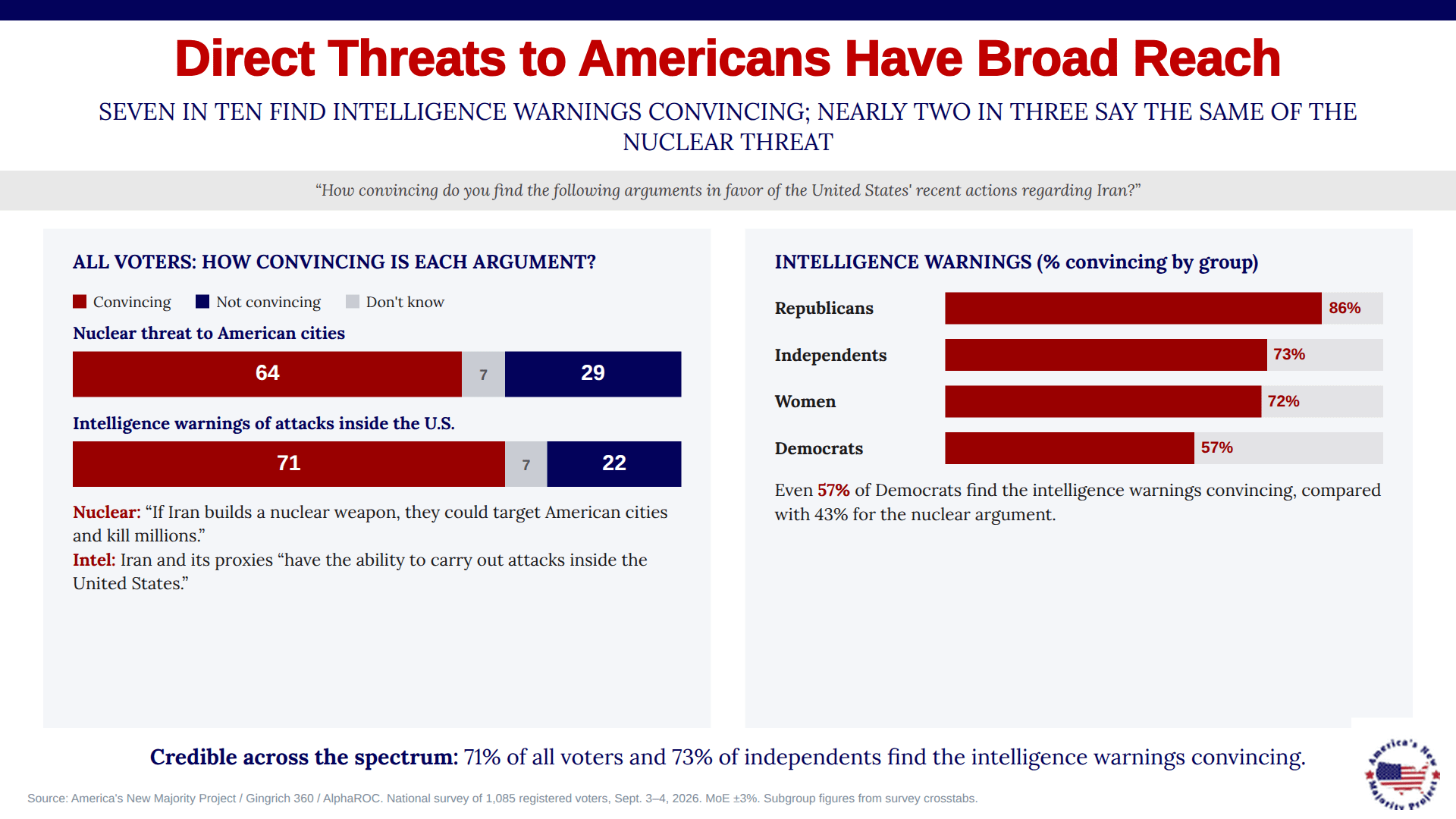
The intelligence warning that Iran and the armed groups it supports can carry out attacks inside the United States is convincing to 71% and not convincing to 22%.
The Strait of Hormuz argument that Iranian control could raise global energy prices and impose costs on American households is convincing to 71% of voters.
The nuclear argument - that near-weapons-grade enrichment could lead to a weapon capable of targeting American cities is convincing to 64% and not convincing to 29%.
Direct Threats to Americans Have Broad Reach
The intelligence warning is convincing to 71% of all voters, including 73% of independents and 57% of Democrats.
The nuclear-threat argument is convincing to 64% overall and 64% of independents. One in three voters (33%) find it very convincing.
Women find the intelligence warning convincing 72% to 17%. Among voters age 65 and older, 78% find it convincing.
Oil and Gas: Convincing, But More Likely to Backfire
The Strait of Hormuz message initially looks like one of the strongest arguments in the survey. Voters were told that Iran was trying to control a waterway carrying about 20% of the world’s oil and that closing it would raise global energy prices and leave American households with the cost.
The argument convinces 71% of voters, including 71% of independents and 84% of Republicans.
But 26% of all voters say at least one of the ten arguments made them less supportive of recent U.S. actions. 57% say no argument made them less supportive.
Among that 26% group, 38% identify the oil-and-gas argument - the largest share for any message tested. Among independents in that group, 46% identify oil and gas.
That 38% is not 38% of all voters; it is the share of the smaller group who said at least one argument reduced their support. The finding is best read as a warning about emphasis.
Voters Take the Threat at Its Word
A majority, 55%, say Iran’s leaders really mean it when they chant “Death to America,” while 30% say it is primarily political rhetoric. Independents say they mean it 62% to 24%.
Asked what is likely if the United States ends military action and sanctions, the most-selected outcome is Iran building one or more nuclear weapons (25%). About the same share expect attacks on a U.S. ally (24%), attacks on Americans at home or overseas (24%), or the situation to remain roughly as it is (24%).
Only 6% expect Iran to reduce its uranium enrichment if U.S. military action and sanctions end.
Support Moves After Voters Hear the Case
Before hearing the arguments, voters oppose recent U.S. actions regarding Iran 52% to 40%. Afterward, they support them 48% to 43% - a 17-point net shift.
Independents move from 35% support to 43%; women move from 30% to 43%; and Democratic support more than doubles from 8% to 20%.
The Bottom Line
The survey presented ten arguments together and does not isolate the effect of any single one. But the pattern is consistent: voters most often choose the nuclear threat as the strongest reason to act, 71% find the intelligence warnings convincing, and after hearing the case, opinion moves from 40% support and 52% opposition to 48% and 43%.
The evidence suggests that a direct threat to Americans, backed by intelligence warnings, is the clearest way to move voters on Iran.
AlphaROC conducted a national survey for Gingrich 360 among 1085 registered voters on September 3-4th, 2026. All interviews were conducted online. Survey invitations were randomly distributed, with demographic balances approximating U.S. census benchmarks. The sample of 1085 registered voters carries a margin of error of ±3.0% at the 95% confidence level.
What’s Next
We have some exciting updates to share about our September survey on Big Government Socialism and how American voters view its policies as we approach the 2026 midterm elections.
We’d love to hear your thoughts! Please share what topics you’d be interested in regarding where American voters stand on various issues.
Expertly & professionally done survey & report. Thanks!!!