


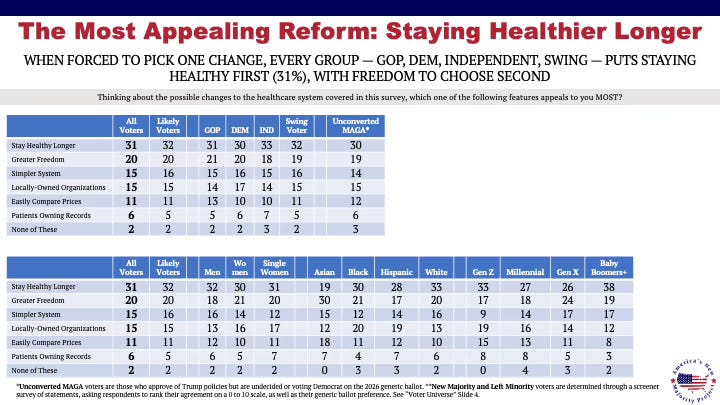
There’s a difference between agreeing with a reform and prioritizing it. The survey asked both, and the gap shows which ideas are ready to lead and which need to earn their place.
Key Takeaways
Americans believe healthcare costs are the result of structural problems in the healthcare system—not simply the high cost of medical care. Fifty-eight percent say the best path to affordability is fixing the underlying problems that make healthcare expensive and complicated, and, by 73% to 22%, voters say healthcare is expensive because organizations profit from the system's complexity rather than because of the actual cost of high-quality care.
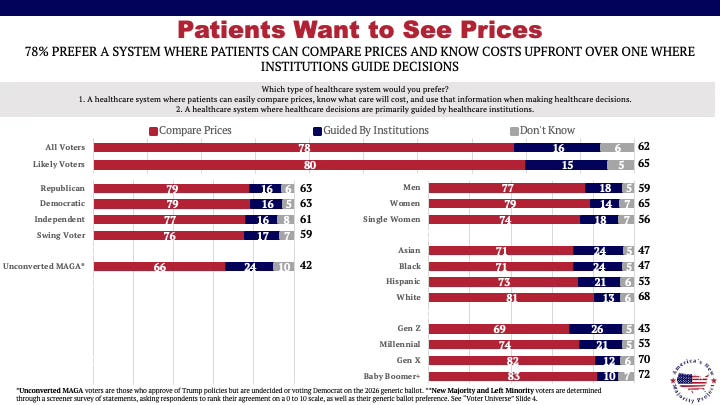
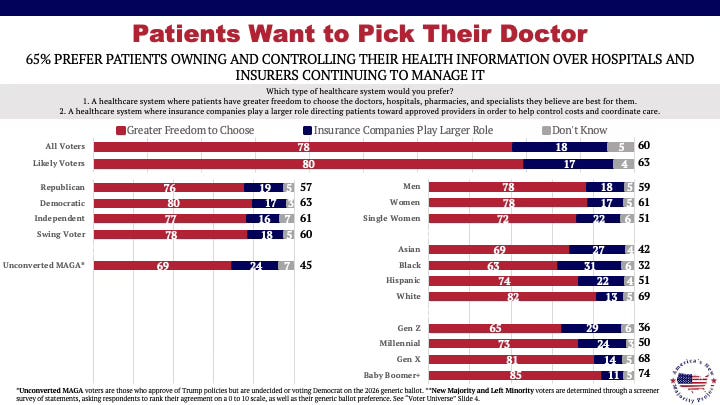
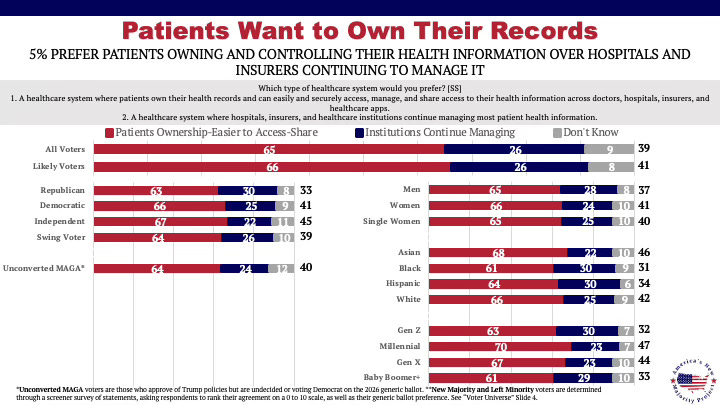
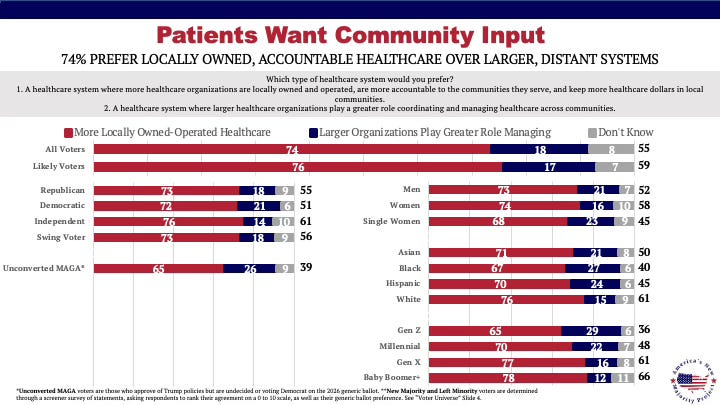
Across six different reform areas, voters consistently preferred solutions that shift power from healthcare institutions to patients. Patients comparing prices themselves (78%), choosing their own doctors (78%), locally accountable organizations (74%), and owning their own health records (65%) all won decisively.
Rather than describing six separate policy ideas, the findings point toward a remarkably consistent public vision for how a better healthcare system should work: one that is simpler (94% agree), more transparent (93%), more locally accountable (93% concerned by distant decision-making), and focused on keeping people healthy (97%).
Why It Matters
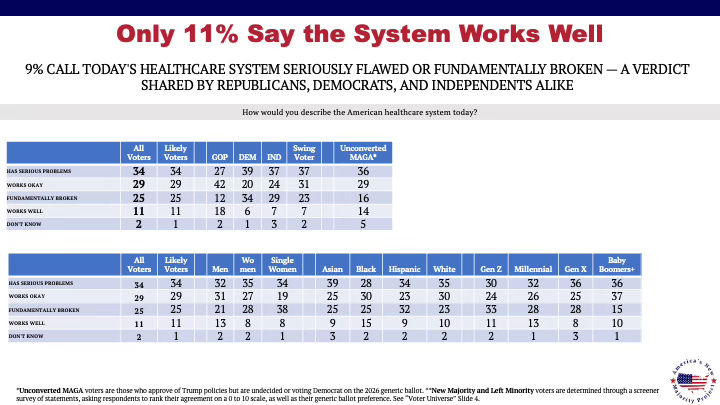
These numbers describe something rare: an issue where Americans largely agree. Whatever their politics, voters are frustrated by the same things—insurance restrictions, confusing bills, decisions made far from home—and they want the same fixes: a simpler system, real prices, more say over their own care, and a focus on staying healthy. Only 11% think the system works well today. That shared frustration, and the shared vision behind it, is why these results matter.
How To Use This Data
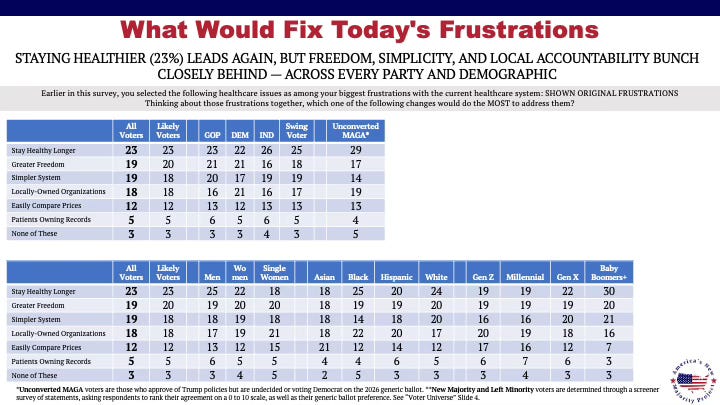
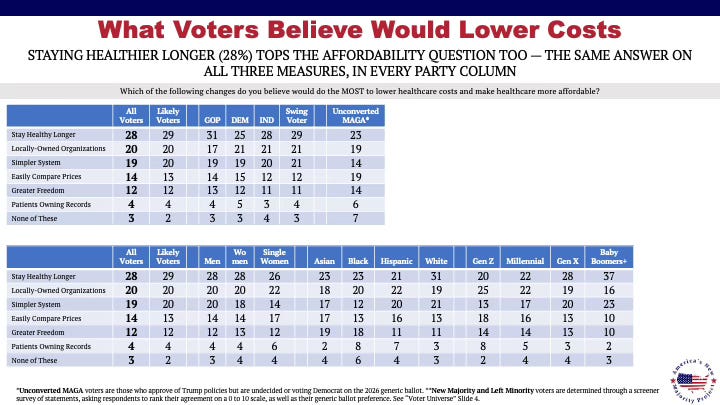
Lead with reducing insurance restrictions and simplifying the system when talking about today’s frustrations — these arguments already carry emotional weight. Use helping people stay healthier longer to build the positive, forward-looking case; it finished first on every prioritization measure. Save health records for supporting detail rather than a headline: voters agree with it, but it hasn’t yet earned urgency.
Patients Consistently Beat Institutions
The most striking pattern in the survey is how consistently voters sided with patients over institutions.
Across every major reform tested, the patient-centered option won decisively.
78% prefer a system where patients compare prices rather than one where healthcare institutions primarily guide decisions.
78% prefer greater freedom to choose doctors over a system where insurance companies play a larger role directing patients.
65% prefer patients owning their health records rather than hospitals and insurers managing them.
74% prefer more locally owned and accountable healthcare organizations over larger organizations managing healthcare across communities.
Although each proposal addressed a different issue, the pattern remained remarkably consistent. Taken together, these findings suggest patient control is a defining feature of voters’ broader vision for a better healthcare system.
A Pattern That Crosses Every Line: Party, Age, and Region
The crosstabs reveal why this pattern is so significant: it holds across nearly every demographic group in the survey.
Party barely matters. Greater freedom to choose doctors wins 76% of Republicans, 80% of Democrats, and 77% of independents; locally accountable healthcare wins 71%, 75%, and 73%; patient-owned records wins 63%, 66%, and 67%. On no question do the parties diverge by more than a few points.
Both 2024 coalitions agree. Trump voters and Harris voters land within roughly one to four points of each other on every patient-control question tested — a rare instance of the two electorates describing the same solution.
Intensity rises with engagement. Likely voters back locally accountable healthcare at 75% versus 62% among less-likely voters, and definite voters prefer patients comparing prices at 79% versus 66% — the voters most certain to show up feel this most strongly.
Age shapes the entry point, not the verdict. Seniors are the strongest supporters of local accountability (79% among voters over 65), while voters 35–54 are the strongest supporters of owning their records (68–70%) and price comparison peaks at 81% among ages 55–64 — every age group lands on the same side.
A healthcare vision that unites Republicans, Democrats, independents, both 2024 coalitions, and every age group is not a partisan message — it is an emerging consensus.
The Bottom Line:
Voters aren’t really answering a question about who pays. Across structure, complexity, control, transparency, prevention, and accountability, the data shows Americans keep describing the same healthcare system: simpler, more transparent, more patient-directed, more locally accountable, and more focused on keeping people well.
What’s Next
We will have more analysis on recent polling on what’s next for America’s healthcare system.
We want to hear from you! We love hearing from our subscribers and use your feedback to share the most current, engaging policy information. Share how you’re using this data or tell us what new insights you’d like to see.
Get in touch with us anytime, and let’s make an impact together!
We need a Doge approach to what each medical procedure actually costs. There has been excessive cost shifting in medical care for the insurance companies and hospitals to know the actual cost of each procedure.
Worthwhile undertaking the challenge.