


Half the country had never heard of this law before being surveyed 51% said they had no idea it existed. That makes these results a clean measure of first reaction, and the first reaction is broad-based opposition that spans party, age, race, and income.
Key Takeaways
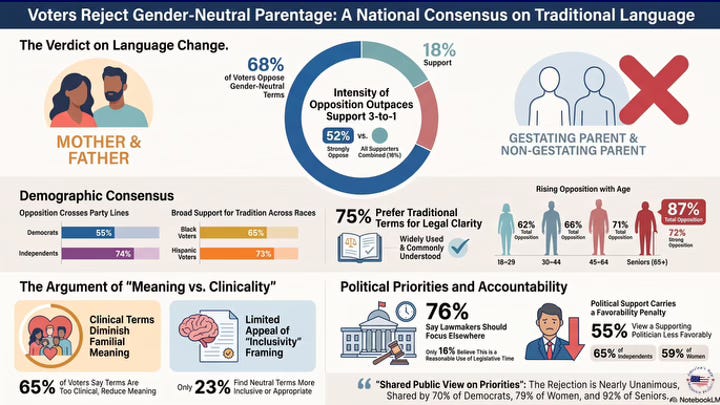
68% of voters oppose the change, including 52% who strongly oppose. Strong opposition alone is nearly three times total support (18%).
75% say state law should keep “mother” and “father” because the words are widely used and commonly understood; only 14% prefer gender-neutral legal terms.
The public sees this as a question of legislative priorities as much as language. 76% of voters, including 70% of Democrats, say lawmakers should be spending their time on other issues.
Why It Matters
Legal language shapes how families are described in official documents, court records, and public forms. This survey shows a wide gap between the words lawmakers chose and the words the public actually uses. 75% of respondents — across every major demographic and party — want to keep “mother” and “father.” That means this change never had real public support behind it.
That gap has political costs. When officials adopt language most voters don’t use, it tells those voters their leaders don’t know them or share their values. Issues like this don’t stay quiet — they become wedge issues, forcing officials to choose between the advocacy groups who pushed the change and the much larger, cross-partisan majority who wanted things left alone. That’s a tough spot for anyone facing reelection.
How To Use This Data
Lead with the priorities finding. The single most lopsided result in the survey is that 76% of voters, including 70% of Democrats and 80% of independents, say lawmakers should spend their time on other issues. This framing allows people who may differ on questions of gender and language to find common ground on how legislative time should be spent. The intensity numbers 52% strongly opposed — demonstrate that this is a deeply held view, not a soft one, which is useful context when presenting the findings to officials, media, or community groups.
Voters Reject the Change Itself
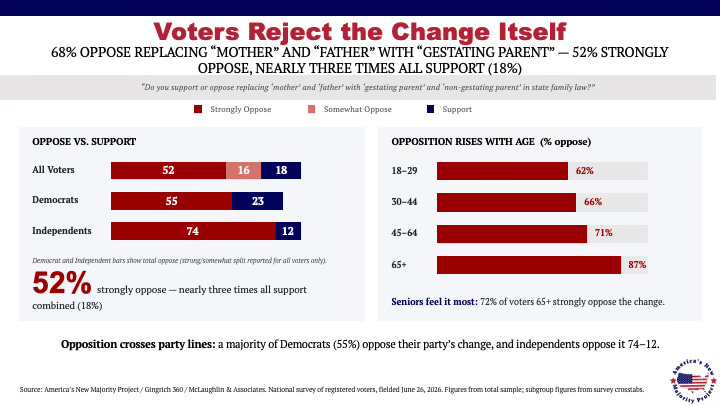
68% oppose replacing “mother” and “father” with “gestating parent” and “non-gestating parent,” versus 18% who support it. 52% strongly oppose — nearly three times all support combined.
Opposition rises with age: 62% of voters 18–29, 66% of those 30–44, 71% of those 45–64, and 87% of seniors — 72% of whom strongly oppose.
Opposition crosses party lines: a majority of Democrats (55%) oppose the change, against 23% who support it. Independents oppose it 74–12.
Voters Reject the Premise
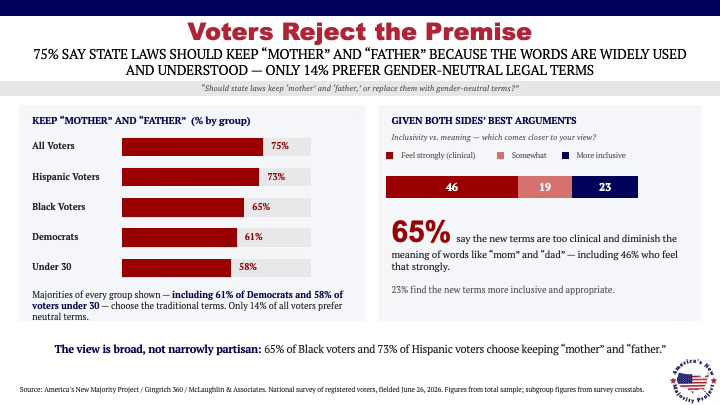
75% say state laws should keep “mother” and “father” because they are widely used and commonly understood; 14% prefer neutral terms. Even 58% of voters under 30 and 61% of Democrats choose the traditional terms.
Presented with both sides’ best arguments — inclusivity versus meaning — 65% say the new terms are too clinical and diminish the meaning of words like “mom” and “dad,” including 46% who feel that strongly. 23% find them more inclusive and appropriate.
The view is broad, not narrowly partisan: 65% of Black voters and 73% of Hispanic voters choose keeping “mother” and “father.”
The Priorities Question
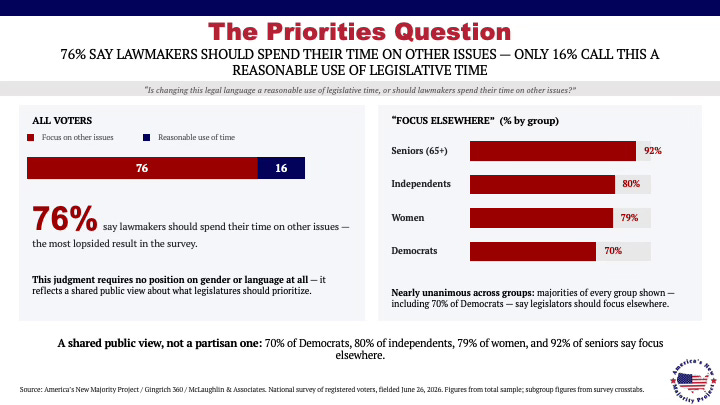
76% say lawmakers should spend their time on other issues; only 16% call this a reasonable use of legislative time.
That view is nearly unanimous across groups: 70% of Democrats, 80% of independents, 79% of women, and 92% of seniors say legislators should focus elsewhere.
Notably, this judgment requires no position on gender or language at all — it reflects a shared public view about what legislatures should prioritize.
Public Accountability
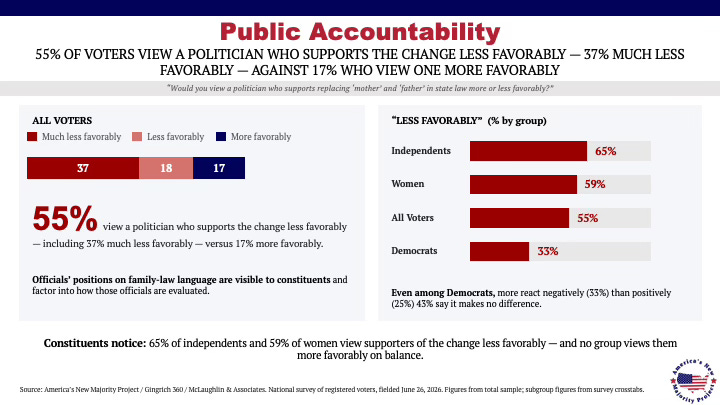
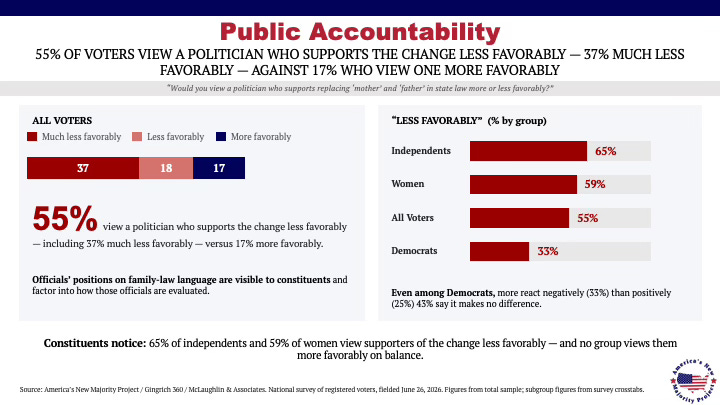
55% of voters view a politician who supports the change less favorably (37% much less favorably); 17% view such a politician more favorably.
Among independents, 65% view supporters of the change less favorably; among women, 59%. Even among Democrats, more voters react negatively (33%) than positively (25%), with 43% saying it makes no difference.
These findings indicate that public officials’ positions on legal family-law language are obvious to constituents and factor into how those officials are evaluated.
The Bottom Line
New York adopted a change to family-law terminology that most Americans had never heard of, that three-quarters believe should not have been a legislative priority, and that a majority strongly oppose on the merits. The data show a durable, cross-demographic public consensus in favor of retaining “mother” and “father” in state law. For advocates, researchers, and policymakers, these findings offer a clear picture of public opinion to inform debate over similar proposals in other states.
AlphaROC conducted a national survey for Gingrich 360, among 1454 registered voters on June 27th to June 28th, 2026. The sample of 1454 registered voters carries a margin of error of ±2.6% at the 95% confidence level.
What’s Next
We will have more analysis on recent polling on whats next for America’s healthcare system..
We want to hear from you! We not only enjoy hearing from our subscribers, but we also use your feedback to bring you the most recent and engaging policy information available. Share how you’re using this data or tell us what new insights you’d like to see.
Get in touch with us anytime, and let’s make an impact together!
Wonder what "God the Creator of all will say about that on the day that He judges this world and all that is in it."