

Key Takeaways
Americans believe the economy can work better, but they are looking for a positive vision—not simply more redistribution.
By nearly two to one, voters prefer improving how markets create opportunity over relying primarily on taxes and government programs to help those left behind.
When offered three distinct economic philosophies, a majority chooses improving the rules that shape markets over both minimal-government capitalism and redistribution.
Support for improving how markets work extends across party lines, with the majority of Republicans, Democrats, and Independents all choosing this approach.
The findings suggest the appeal of redistribution may depend in part on the absence of a compelling alternative focused on creating broader opportunity.
Why It Matters
The recent rise of democratic socialism has led many observers to conclude that Americans are moving away from capitalism and toward redistribution.
Our findings suggest a different possibility.
Many voters may not be rejecting markets at all. Instead, they appear to be looking for a compelling vision for creating broader prosperity. When offered a positive alternative focused on improving competition, expanding opportunity, and helping more Americans succeed through work, voters overwhelmingly prefer that approach over relying primarily on redistribution.
If that’s true, the debate may be less about capitalism versus socialism than about whether political leaders can articulate a credible plan for building an economy that works for more Americans.
How To Use This Data
Economic messages should emphasize creating opportunity, not simply redistributing income.
Rather than defending the status quo or promising larger government programs, policymakers should focus on improving the rules that shape markets so businesses compete, workers earn better wages, entrepreneurs can succeed, and more Americans have the opportunity to prosper through their own efforts.
Most Americans Believe the Economy Can Work Better
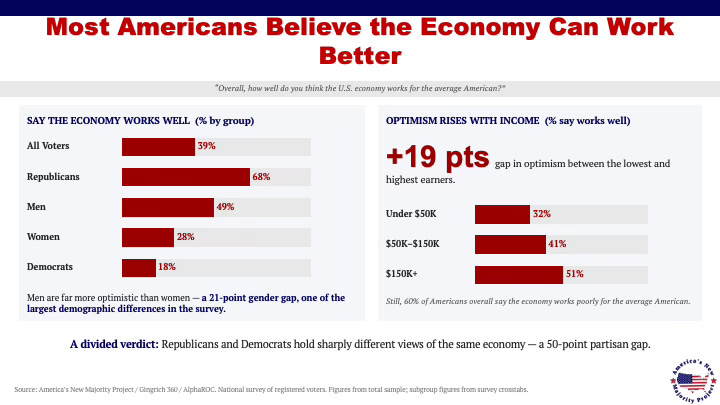
Overall, 60% of Americans say the U.S. economy works somewhat or very poorly for the average American, while 39% say it works somewhat or very well.
Republicans are significantly more positive about today’s economy (68% well) than Democrats (18% well), reflecting sharply different assessments of current economic conditions.
Men are far more optimistic than women. Nearly half of men (49%) say the economy works well for the average American, compared to just 28% of women—a 21-point gender gap, one of the largest demographic differences in the survey.
Lower-income Americans are substantially more negative than higher-income Americans. Positive assessments rise steadily from 32% among those earning under $50,000 annually to 51% among those earning $150,000 or more.
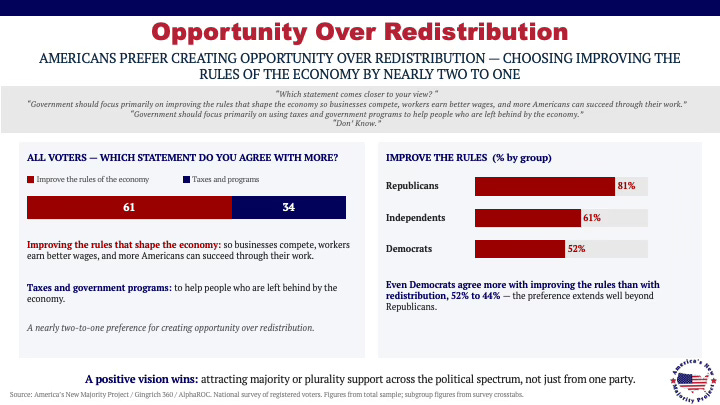
Americans Prefer Creating Opportunity Over Redistribution
When asked to choose between two approaches, 61% say government should focus primarily on improving the rules that shape the economy so businesses compete, workers earn better wages, and more Americans can succeed through their work.
Just 34% prefer focusing primarily on taxes and government programs to help people who are left behind by the economy.
Republicans favor improving the rules by 81% to 16%.
Independents favor improving the rules by 61% to 33%.
Even Democrats favor improving the rules over redistribution, 52% to 44%.
The preference for creating broader opportunity extends well beyond Republicans, attracting majority or plurality support across the political spectrum.
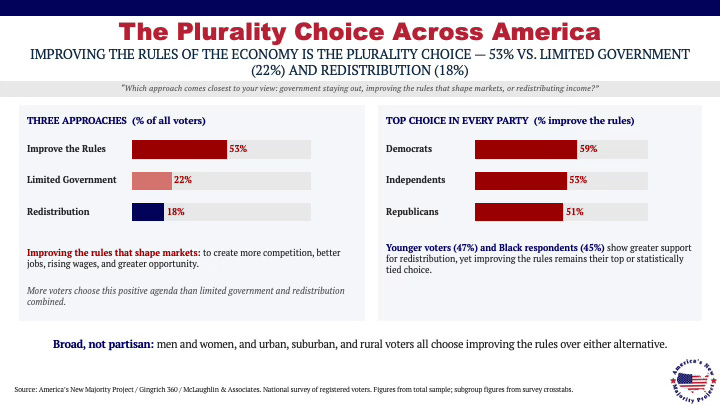
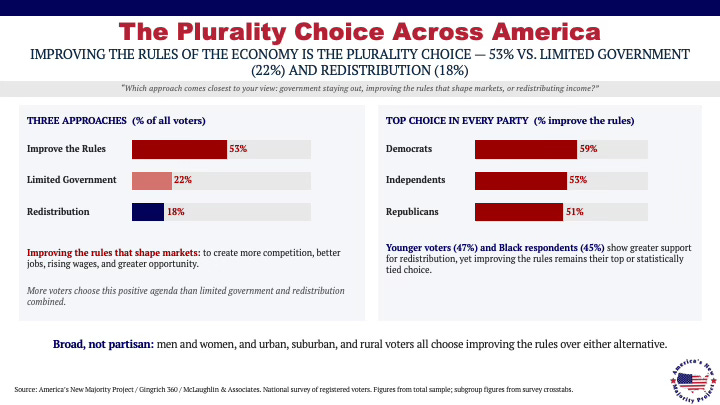
Improving the Rules of the Economy Is the Plurality Choice Across America
When voters are presented with three distinct approaches to the economy—limited government, improving the rules that shape markets, or redistribution—they consistently choose improving the rules.
53% choose improving the rules that shape markets to create more competition, better jobs, rising wages, and greater opportunity, compared to 22% who prefer government mostly staying out of the economy and 18% who prefer relying more on taxes and government programs to redistribute income.
Republicans (51%), Democrats (59%), and Independents (53%) all identify improving the rules as their preferred approach.
Men and women, as well as urban, suburban, and rural voters, also choose improving the rules over either alternative.
Younger voters (28%) and Black respondents (31%) express greater support for redistribution than the overall electorate. Even so, improving the rules remains the top choice among younger voters (47%) and is statistically tied with redistribution among Black respondents (45% improve the rules; 47% redistribute).
The Bottom Line
The results suggest Americans are not simply choosing between defending today’s economy and expanding redistribution.
When presented with a positive vision focused on creating broader opportunity—through stronger competition, better jobs, rising wages, and greater opportunity—they overwhelmingly prefer that approach to relying primarily on redistribution.
That finding suggests economic messaging may be strongest when it focuses on how to build an economy that works for more Americans, rather than framing the debate as a choice between the status quo and larger government programs.
AlphaROC conducted a national survey for Gingrich 360, among 1261 registered voters on July 11th to July 12th, 2026. The sample of 1261 registered voters carries a margin of error of ±2.8% at the 95% confidence level.
What’s Next
We will have more analysis from our ongoing polling on whats influencing the American voter in this years Mid-Term elections.
We want to hear from you! We not only enjoy hearing from our subscribers, but we also use your feedback to bring you the most recent and engaging policy information available. Share how you’re using this data or tell us what new insights you’d like to see.
Get in touch with us anytime, and let’s make an impact together!
Have a "write-in : Ask Americans to make suggestiins in how to create more job opportunity in the American economy.
The U.S. has a mixed model economy. We have elements of both capitalism and socialism. Excessive socialism is causing most of the problems in the U.S. economy today. The best way to create an economy that works for more Americans is to get rid of the socialism. This includes cutting government regulations and bureaucracy, reducing taxes, reducing inflation, decreasing government spending and paying down the federal deficit.