

Key Takeaways
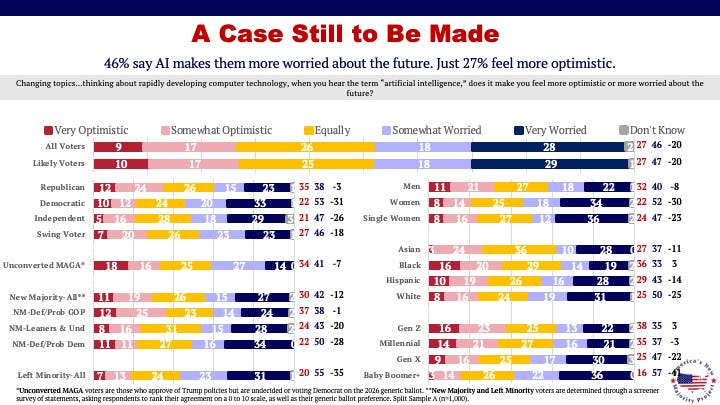
Voters are more worried than optimistic about AI. 46% say “artificial intelligence” makes them more worried about the future. Only 27% feel more optimistic. Very worried voters outnumber very optimistic voters 3 to 1 (28% to 9%).
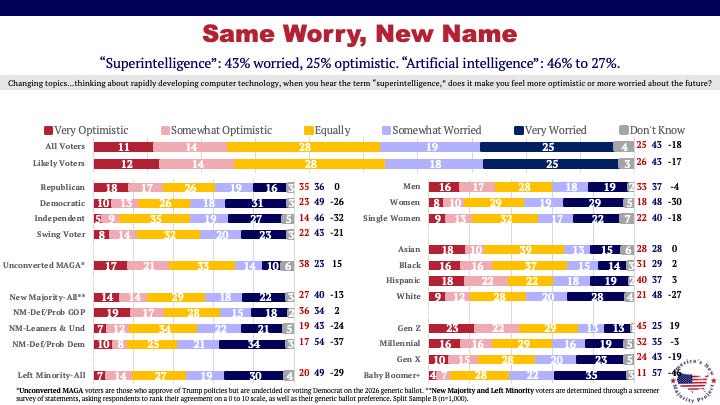
A new name changes little. Voters react about the same to “superintelligence” as to “artificial intelligence” (43% vs. 46% worried). Asked directly, only 32% say it is a better name; 50% disagree.
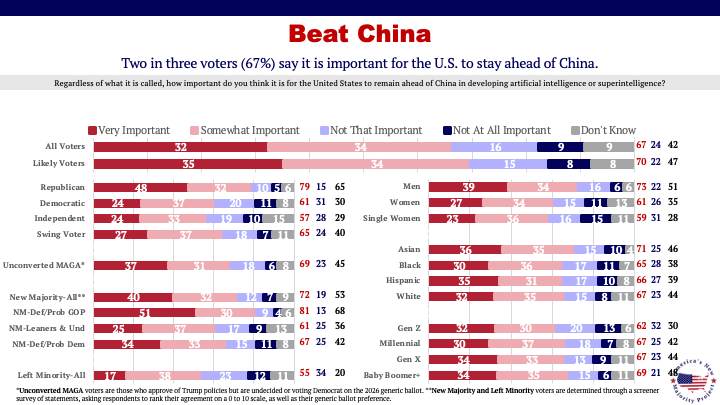
Beating China is a consensus. 67% say it is important for the United States to stay ahead of China in developing AI, including 79% of Republicans, 61% of Democrats, and 57% of independents.
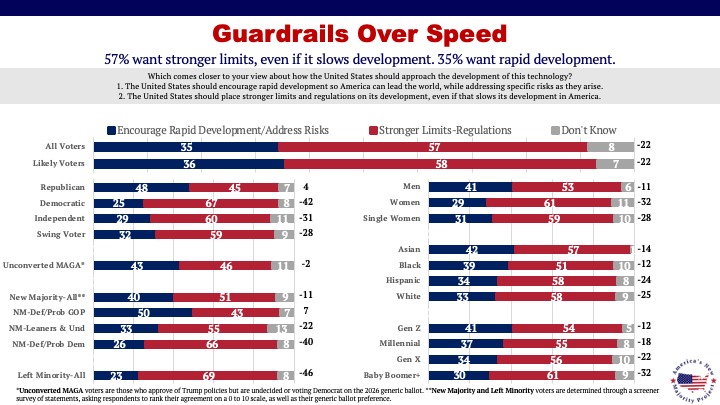
But voters want guardrails over speed. By 57% to 35%, voters prefer stronger limits and regulations on AI, even if that slows its development in America. Republicans are split, 48% to 45%.
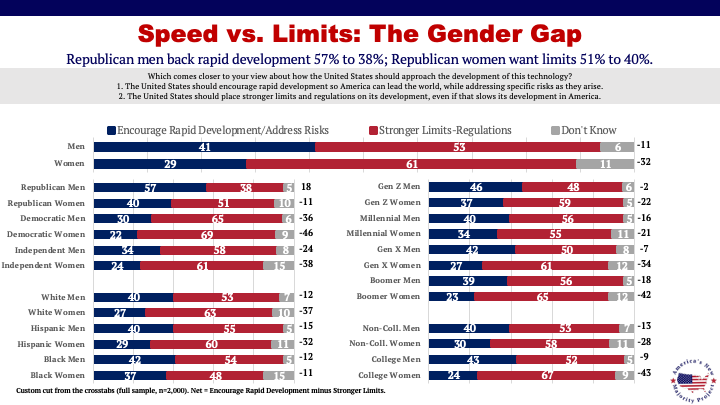
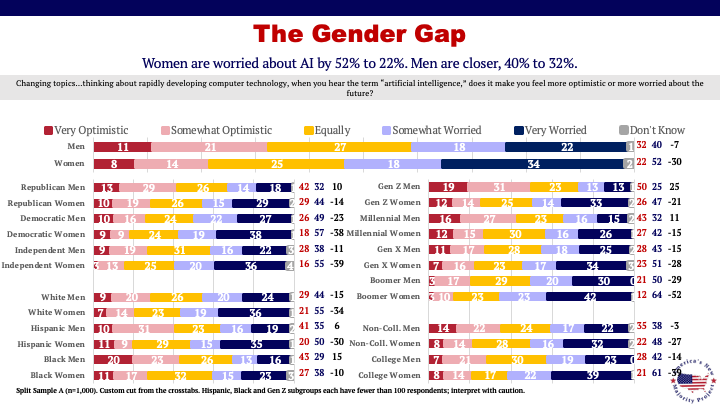
AI has a gender gap, even among Republicans. Women are worried about AI by 52% to 22%. Men are closer, 40% to 32%. Republican men favor rapid development by 57% to 38%, while Republican women favor stronger limits by 51% to 40%.
Why It Matters
AI is moving from a technology story to a political issue. Voters hold two views at once: they want America to win the race with China, and they want protection from its risks. A message built only on speed loses the middle. A message built only on fear ignores the China consensus. Independents, swing voters, and women favor stronger limits by wide margins, and they are the voters who decide close races.
How To Use This Data
Lead with American leadership over China. It is the strongest and broadest point in the data. Then pair it with protections, because voters want both. Avoid “go fast and fix it later” framing: even Republicans are only narrowly behind it.
A Case Still To Be Made
When voters hear “artificial intelligence,” their first reaction is concern, not excitement.
Worry wins: 46% say AI makes them more worried about the future. Only 27% say it makes them more optimistic, and 26% feel both equally.
The intensity is on the worried side: 28% are very worried. Just 9% are very optimistic.
Even Republicans are not sold: 35% of Republicans are optimistic and 38% are worried. Trump voters split the same way, 34% to 38%. Democrats (53% worried) and independents (47% worried) are far more concerned.
A large age gap: Voters 65 and older are worried by 56% to 16%, while voters 18 to 44 are evenly split (36% optimistic, 37% worried).
Little Benefit from Changing Name. A split sample were asked the same questions using the term “superintelligence” instead of “artificial intelligence.” The differences in results are neglibible. Asked directly if it was a better name, 32% agreed, 50% disagreed.
The takeaway is clear: AI is not an automatic applause line. For most voters, it starts as a worry that has to be answered.
Beat China, But Keep Guardrails
Voters want America to win, and they want it done safely.
Win the race with China: 67% say it is important for the U.S. to stay ahead of China in developing this technology, with 32% saying very important. Only 24% say it is not important.
Across party lines: 79% of Republicans, 61% of Democrats, 57% of independents, 65% of swing voters, and 72% of the New Majority say staying ahead of China matters.
But limits beat speed: 57% say the U.S. should place stronger limits and regulations on AI, even if that slows its development in America. 35% say America should encourage rapid development and address risks as they arise.
The base is divided: Republicans favor rapid development by just 48% to 45%. Trump voters are 49% to 44%. Unconverted MAGA voters lean toward limits, 46% to 43%.
The middle wants limits: Independents prefer stronger limits by 60% to 29%, swing voters by 59% to 32%, undecided congressional voters by 53% to 23%, and women by 61% to 29%.
The message is simple: “go fast and fix it later” does not sell. “America must lead, and lead responsibly” unites voters across party lines.
AI Has a Gender Gap
The sharpest divide on AI is not only between parties. It is between men and women, and it shows up inside every group.
Men are split, women are worried: Men are worried by 40% to 32%. Women are worried by 52% to 22%, more than 2 to 1.
Republican men and women land on opposite sides: Republican men are optimistic about AI, 42% to 32%, and favor rapid development, 57% to 38%. Republican women are worried, 44% to 29%, and favor stronger limits, 51% to 40%.
The gap holds everywhere: Men are more optimistic than women in every party, racial group, generation, and education level in the survey. Millennial men are optimistic by 43% to 32%, while millennial women are worried by 42% to 27%.
The most worried voters in the survey: Baby Boomer women are worried by 64% to 12%. Independent women are worried by 55% to 16%, and only 47% of them say staying ahead of China is important.
Common ground on China: Even so, 61% of women and 74% of Republican women say it is important for America to stay ahead of China on AI.
A message built only on speed and winning will connect with men, but it will miss women, including Republican women. Pairing American leadership with real protections reaches both.
The Bottom Line
Voters want America to lead the world in AI and beat China. They also do not trust the technology to manage itself. The strongest message pairs both: American leadership with real protections. A message built only on speed, or only on a new name, misses where voters are.
McLaughlin & Associates partnered with Gingrich360 to conduct a national survey for America’s New Majority Project. This national survey was conducted among 2,000 registered voters between September 25-29, 2026.
The sample of 2,000 registered voters has an accuracy of +/- 2.2% at a 95% confidence interval. The numbers in this presentation have been rounded and may not equal 100%.
What’s Next
We have much more from the recent poll from the end of September on how American voters view the 2026 midterm elections.
We’d love to hear your thoughts! Please share which topics you’d like to see on where American voters stand on various issues.