


Key Takeaways
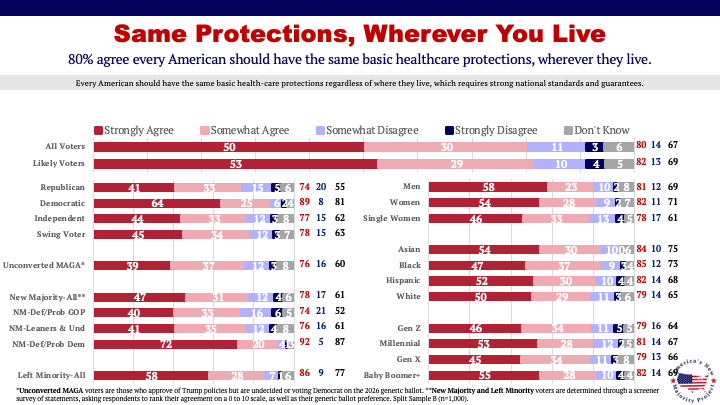
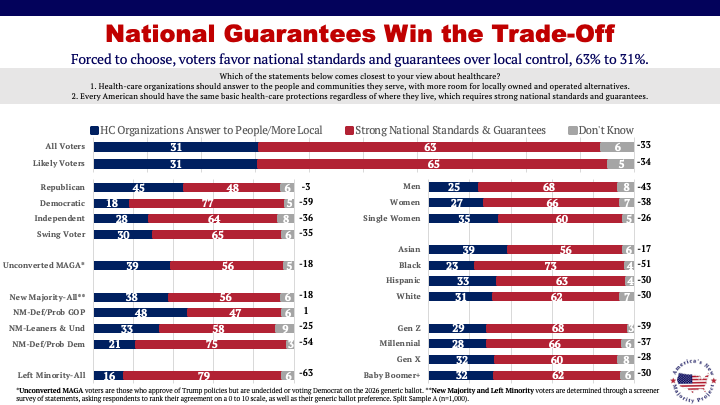
80% agree every American should have the same basic healthcare protections, regardless of where they live. When forced to choose, voters prefer national guarantees over local healthcare autonomy, 63% to 31%.
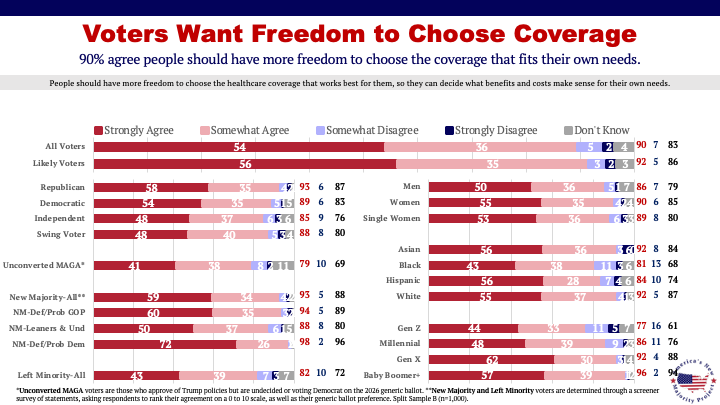
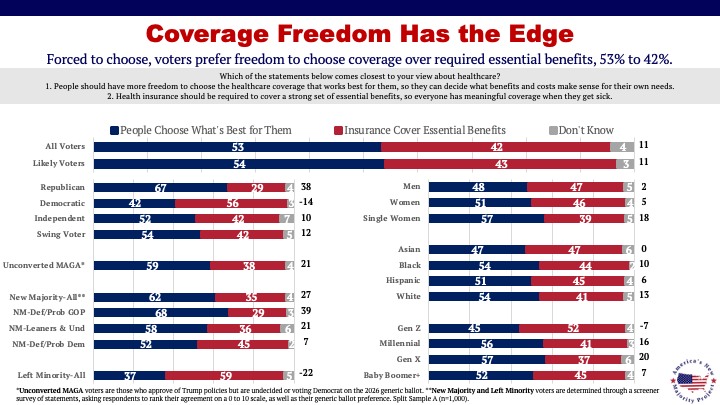
90% support greater freedom to choose healthcare coverage that fits their needs. When forced to choose, voters favor coverage flexibility over required essential benefits, 53% to 42%.
87% agree patients and doctors—not insurance companies, hospital systems, or government bureaucracies—should control healthcare decisions.
93% express concern about healthcare decisions being made by large organizations far from the communities they serve.
Medicare for All is back in the spotlight as prominent Democratic socialists embrace the single-payer proposal. The act would create a national health insurance program with comprehensive benefits, eventually prohibiting private and employer plans that duplicate them.
It would not simply offer another option, it would replace much of Americans’ current coverage, including plans that work well for them. That trade-off is significant and new polling from America’s New Majority Project (ANMP) shows why it poses a vulnerability.
Why It Matters
Given what would be the largest change in American domestic policy since the Social Security Act of 1935, these findings provide a framework for examining Medicare for All’s trade-offs, and for developing alternatives that combine affordable care, national protections, personal choice, and local accountability.
How To Use This Data
For those making the case against Medicare for All, the findings suggest emphasizing what would change for patients rather than defending the existing insurance system.
Do:
✓ Make it personal. Explain that Medicare for All would replace existing health plans, including coverage families receive through work. Emphasize the importance of being able to keep a plan that works.
✓ Lead with patient control and access to care. The key questions are whether patients keep meaningful choices, can see the doctors they trust, and can get the treatments they need.
✓ Be on the side of reform. Lower costs, stop unfair insurance denials, simplify healthcare, and ensure people can afford necessary care.
✓ Pair choice with security. Alternatives should combine consistent national protections with meaningful insurance choices and locally accountable care.
Don’t:
✗ Frame the argument as protecting private insurance. The issue is protecting people’s choices, not the insurance industry’s.
✗ Rely primarily on enormous spending estimates or labels such as “socialism.” Explain the practical implications for coverage and care.
✗ Turn patient choice into another burden of shopping for complicated insurance plans or navigating additional paperwork.
Voters Want National Guarantees, Not a Single National Plan
ANMP’s September survey found overwhelming support for basic national healthcare protections and local accountability.
80% agreed every American should have the same basic healthcare protections regardless of where they live, requiring strong national standards and guarantees.
83% agreed healthcare organizations should answer to the people and communities they serve, with more room for locally owned and operated alternatives.
When voters had to choose between them:
63% favored national standards and guarantees.
31% favored local accountability and locally operated alternatives.
This preference is not new. In May 2022, ANMP polling found voters preferred nationally consistent healthcare laws and regulations over locally determined rules, 55% to 35%.
The takeaway is that Americans want reliable healthcare protections regardless of where they live.
Medicare for All’s Coverage-Choice Problem
The September survey also tested voters’ desire for flexibility.
Asked separately:
90% agreed people should have more freedom to choose healthcare coverage that works best for them, including deciding what benefits and costs fit their needs.
86% agreed health insurance should be required to cover a strong set of essential benefits so everyone has meaningful coverage when they get sick.
But when forced to choose:
53% preferred greater freedom to choose coverage, benefits, and costs.
42% preferred requiring insurance to cover a strong set of essential benefits.
Voters clearly value both meaningful insurance protections and flexibility. When those principles compete, however, coverage freedom has the advantage.
That is directly relevant to the design of Medicare for All.
Under the proposal, people who are happy with the health plan their family receives through work wouldn’t be able to keep it. Instead, they would have just one option: the national plan run by the federal government.
The Bottom Line
Americans support national healthcare protections. They also want insurance choices that fit their needs and patient- and doctor-driven healthcare decisions with accountable providers.
Medicare for All would offer comprehensive national coverage. It would also replace existing health plans and put coverage and payment rules under a single federal program.
An alternative approach can be built around three principles: adequate protection, meaningful freedom to choose coverage, and healthcare decisions made as close as possible to patients.
Research methodology: McLaughlin & Associates surveyed 2,000 registered voters nationwide online, September 25–29, 2026 (full-sample margin of error ±2.2 percentage points). Healthcare standalone and forced-choice measures were administered to separate half-samples of 1,000 respondents.
What’s Next
We’ll continue examining what ANMP’s latest healthcare research and the reforms Americans believe will make healthcare work better.
Next month, ANMP has several focus groups scheduled to follow up on post-election reactions and the issues the American public is looking for Washington to tackle.
We welcome your feedback and suggestions for additional research.